





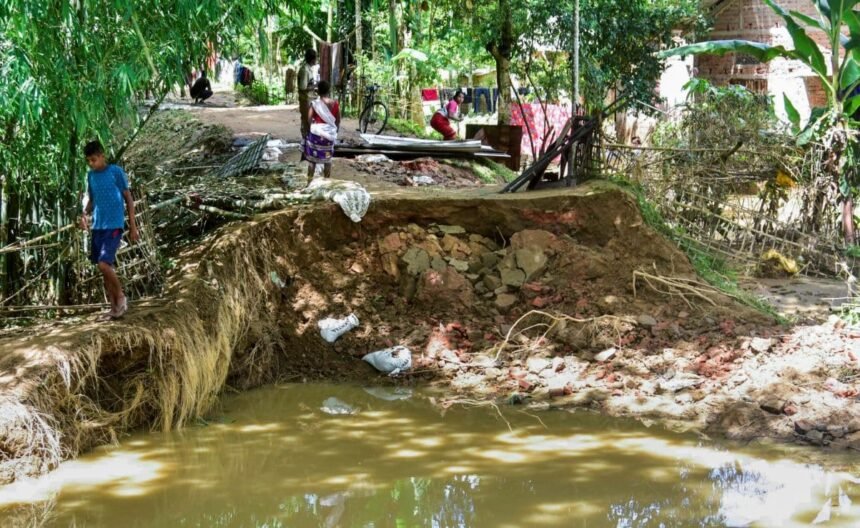
The flood situation in Assam has deteriorated further after 21 more people lost their lives, taking the humanitarian crisis to a new level. According to the Assam State Disaster Management Authority (ASDMA), nearly 5.65 lakh people have been affected across 12 districts following continuous heavy rainfall. Sivasagar district reported the highest number of deaths, while floodwaters have submerged large areas, displaced thousands of residents, and disrupted normal life. Authorities continue relief and rescue operations as rainfall persists across the state.
Read More: Sikkim Tunnel Collapse Kills 10 Workers in Namchi
Key Facts
- People Affected: Nearly 5.65 lakh
- Deaths Reported: 21 in the latest update
- Worst-Hit District: Sivasagar
- Affected Districts: 12
- Agency Monitoring the Situation: Assam State Disaster Management Authority (ASDMA)
- Cause: Continuous heavy rainfall leading to severe flooding
Flood Situation Becomes More Severe in Assam
The flood crisis in Assam has intensified as continuous rainfall continues to inundate large parts of the state. The latest report from the Assam State Disaster Management Authority (ASDMA) states that nearly 5,64,600 people have been affected across multiple districts.
Moreover, floodwaters have submerged villages, damaged infrastructure, and forced thousands of residents to seek safer locations. Authorities remain on high alert as weather conditions continue to pose challenges.
21 More People Lose Their Lives
The latest floods claimed 21 more lives across the affected districts.
Among the worst-hit areas, Sivasagar district reported 13 deaths, including four women and two children. Meanwhile, Charaideo recorded five deaths, including two children.
In addition, Golaghat reported two fatalities, while Jorhat recorded one death during the past 24 hours.
Over 5.64 Lakh People Affected
According to ASDMA, the floods have affected people in Biswanath, Charaideo, Dhemaji, Dibrugarh, Golaghat, Jorhat, Kamrup, Kamrup Metropolitan, Karbi Anglong, Nagaon, Sivasagar, and Tinsukia districts.
Furthermore, rising water levels have disrupted transportation, affected livelihoods, and damaged homes and public infrastructure in several areas.
Rescue and Relief Operations Continue
State authorities and disaster response teams continue rescue and relief operations in the flood-affected districts.
Meanwhile, officials are distributing relief materials, assisting displaced families, and monitoring river levels to respond quickly to any further emergencies.
However, continuous rainfall has slowed rescue efforts in some locations and increased the risk of additional flooding.
Authorities Monitor Weather Closely
Officials continue to monitor the flood situation as meteorological forecasts indicate the possibility of more rainfall.
Therefore, the administration has urged residents in vulnerable areas to remain alert, follow official advisories, and move to safer locations whenever necessary.
Question & Answer
Q1. What is the latest flood situation in Assam?
Answer: The floods have worsened, affecting nearly 5.65 lakh people across 12 districts.
Q2. How many people died in the latest update?
Answer: Twenty-one people lost their lives in the latest flood-related incidents.
Q3. Which district reported the highest number of deaths?
Answer: Sivasagar district recorded the highest number of fatalities with 13 deaths.
Q4. Which districts are affected by the floods?
Answer: Biswanath, Charaideo, Dhemaji, Dibrugarh, Golaghat, Jorhat, Kamrup, Kamrup Metropolitan, Karbi Anglong, Nagaon, Sivasagar, and Tinsukia.
Q5. What are authorities doing now?
Answer: They are carrying out rescue operations, distributing relief materials, monitoring river levels, and assisting displaced families.
Location Context
Assam, one of Northeast India’s largest states, experiences severe flooding almost every monsoon because of heavy rainfall and overflowing rivers, particularly the Brahmaputra and its tributaries. As a result, timely disaster management and relief operations play a crucial role in protecting lives and restoring normalcy across the region.