




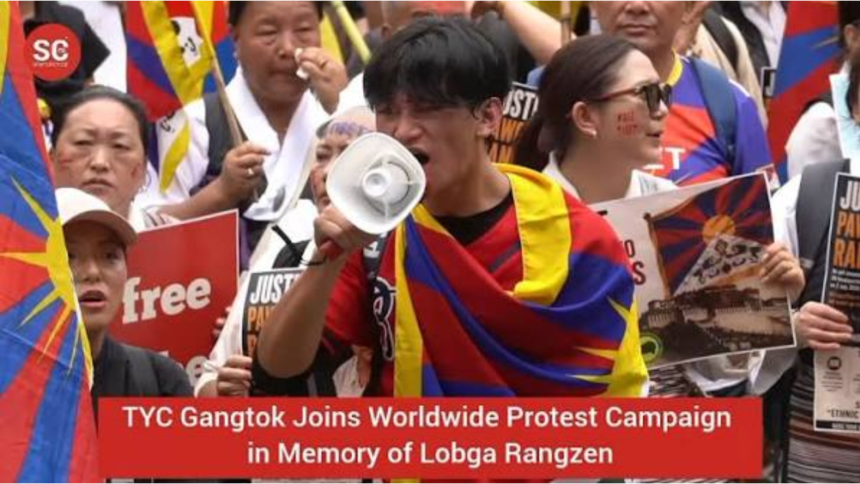
Tibetan youth rally in Gangtok drew attention on Saturday as members of the Regional Tibetan Youth Congress (RTYC) held a peaceful demonstration against China’s new “Ethnic Unity and Progress Law”. The protest was organised in Sikkim’s capital as part of a wider campaign by Tibetan youth groups.
The Gangtok rally also honoured Lobga Rangzen, whom organisers described as a Tibetan martyr who self-immolated outside the United Nations headquarters. Participants used the gathering to highlight their concerns about Tibet, human rights and the preservation of Tibetan identity.
Tibetan youth rally joins global campaign
The Tibetan youth rally was organised by the RTYC, Gangtok, in line with a chain of protests launched by the Tibetan Youth Congress (TYC). Similar demonstrations have been held by Tibetan groups in different countries since China brought the new law into force.
The campaign has focused on what Tibetan organisations describe as growing pressure on their language, culture, religion and national identity. In Gangtok, protesters maintained a peaceful approach while raising political and human rights concerns linked to developments in Tibet.
The demonstration reflects a broader effort by Tibetan youth organisations to keep the Tibet issue visible through public campaigns. Moreover, the groups have sought international attention for what they describe as restrictions on basic rights.
Tibetan youth rally targets new Chinese law
The law at the centre of the protest is formally known as the Law on Promoting Ethnic Unity and Progress. China’s National People’s Congress adopted the legislation on March 12, 2026, and it took effect on July 1.
Chinese authorities present the law as a framework for strengthening ethnic unity and development among the country’s ethnic groups. However, Tibetan organisations and international rights groups have raised concerns about its possible impact on minority identities.
Amnesty International said before the law took effect that it could strengthen assimilation pressures on groups including Tibetans, Uyghurs and Mongolians. The organisation argued that the legislation could promote conformity around a state-defined national identity.
The Tibetan Parliament-in-Exile has also formally opposed the legislation. Its July resolution said the law could further weaken protections for Tibetan cultural, linguistic and religious rights.
Concerns over Tibetan identity
At the Gangtok demonstration, participants criticised the law over what they said could be its impact on distinct communities under Chinese rule. They alleged that the legislation could accelerate assimilation and weaken Tibetan language, religion, culture and heritage.
These remain claims made by Tibetan groups and rights organisations, rather than independent findings establishing that every provision will have those effects. Beijing, meanwhile, describes the legislation in terms of ethnic unity, development and national integration.
The disagreement reflects a wider dispute over how China’s ethnic policies affect minority communities. For Tibetan activists, protecting cultural and religious identity remains a central part of their political campaign.
Tribute to Lobga Rangzen
The Gangtok rally also included a tribute to Lobga Rangzen. Organisers said he self-immolated in front of the United Nations headquarters to draw global attention to the situation in Tibet.
Participants used the tribute to connect the local demonstration with wider Tibetan advocacy efforts. They also called for greater international attention to human rights concerns and political repression in Tibet.
The protesters further urged the United Nations to address what they described as a human rights crisis. They called for accountability and the release of political prisoners, while reiterating demands for Tibetan rights and freedom.
Tibetan youth rally keeps pressure on
The peaceful demonstration in Gangtok is part of a continuing series of protests by Tibetan organisations following the implementation of China’s ethnic unity law. The Tibetan Youth Congress has previously organised demonstrations in India and abroad, including a campaign on July 1 to oppose the legislation.
The issue has also drawn criticism from international rights groups. Amnesty International said the law could entrench assimilation policies, while the International Campaign for Tibet described it as a serious escalation in efforts to assimilate Tibetans.
For the RTYC in Gangtok, the latest rally provided a platform to express opposition without violence. Overall, the demonstration shows how Tibetan youth groups in India continue to use peaceful public action to draw attention to Tibet, cultural identity and human rights concerns.