




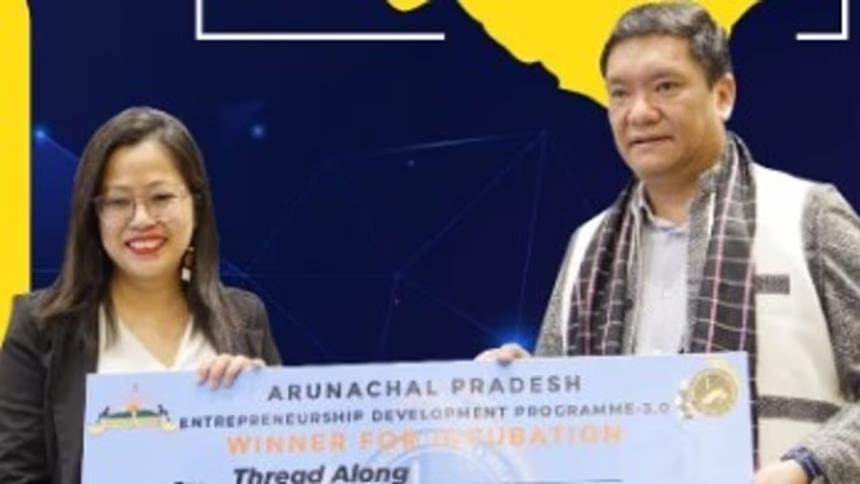
Arunachal Start-up Policy grants are gaining greater importance as the state expands financial and incubation support for emerging entrepreneurs. Under the 2026–27 Arunachal Pradesh Entrepreneurship Development Programme (APEDP 5.0), the government plans to provide seed funding to 100 innovative startups, alongside mentorship, pre-incubation and livelihood acceleration support.
The programme offers ₹10 lakh each to the top 20 selected startups, while another 80 ventures can receive ₹8 lakh each. Moreover, the state’s wider startup policy provides additional support through annual entrepreneurship challenges, incubation facilities and grants for proof-of-concept development.
Gopal Roy Demands Puja Grants for Tripura Clubs
Arunachal Start-up Policy Grants Expand Support for Local Innovation
The latest initiative builds on the Arunachal Pradesh Startup Policy 2022–23, which seeks to develop a stronger entrepreneurship ecosystem across the state. The policy targets at least 250 startups during its policy period and aims to establish incubation facilities in at least half of Arunachal Pradesh’s districts.
Under APEDP 5.0, the government opened applications to entrepreneurs at different stages of venture development, including idea, prototype, early-stage and revenue-generating ventures. However, applicants must demonstrate innovation, originality, scalability and potential economic or social impact.
Therefore, the programme is not limited to established companies. Instead, it creates an opportunity for promising entrepreneurs to develop ideas into more structured ventures with institutional support.
The application process also places emphasis on participation in training, bootcamps, mentoring sessions, workshops, networking programmes, review meetings and pitching activities. Selected ventures must subsequently complete company registration and DPIIT registration as required under the programme.
Seed Funding Gives Early Ventures More Room to Develop
Financial support remains one of the biggest challenges for startups during their early stages. Consequently, the APEDP 5.0 seed-funding structure is designed to give selected entrepreneurs capital that can help them move beyond the initial idea or prototype stage.
The programme provides ₹10 lakh to each of its top 20 startups. Meanwhile, the next 80 selected ventures receive ₹8 lakh each. In total, the programme plans to support 100 innovative startups through this funding component.
The broader state startup framework also provides different levels of financial assistance depending on a venture’s development stage. The official startup portal lists idea-support funding of up to ₹5 lakh for the top ten winners of the annual entrepreneurship challenge and ₹4 lakh for the next 40 winners.
Furthermore, the state scheme includes proof-of-concept support of up to ₹10 lakh for eligible startups that are not accommodated under the central Startup India Seed Fund Scheme. The support can assist with validating a concept, developing prototypes or conducting product trials.
This staged approach allows government assistance to move alongside the development of a startup, from an initial concept to validation and eventually commercialisation.
Incubation Support Connects Entrepreneurs With Expertise
Funding alone cannot guarantee that a startup will succeed. Therefore, Arunachal Pradesh has also developed an incubation ecosystem intended to provide entrepreneurs with mentorship, workspace, networking opportunities and business guidance.
The Arunachal Pradesh Innovation and Investment Park (APIIP) serves as the state’s principal government-owned incubator. The startup portal describes incubation as a process that can provide budding ventures with workspace, mentorship, education, seed-funding access and connections with potential investors.
The state’s incubation guidelines also outline an annual entrepreneurship challenge through which selected startups can receive both financial awards and incubation or pre-incubation opportunities. Under the established process, the top ten ranked startups receive ₹5 lakh and an offer of incubation, while startups ranked from 11 to 50 receive ₹4 lakh and an offer of pre-incubation.
Moreover, entrepreneurs can access incubation through other routes, including applications to eligible higher-education institution entrepreneurship cells and registered incubation organisations.
This ecosystem is particularly important for ventures developing technology-based products or services. Mentoring can help entrepreneurs refine business models, understand markets, improve products and prepare for future investment.
Tribal and Local Entrepreneurs Can Strengthen Arunachal’s Startup Ecosystem
Arunachal Pradesh has a large and diverse tribal population, and the state’s startup strategy places emphasis on supporting local entrepreneurship and innovation. However, the currently available official programme information does not establish that APEDP 5.0 selected a separate category exclusively for “top tribal tech groups.”
Instead, the programme is open to innovative entrepreneurs across the state, with selection based on criteria such as innovation, scalability and economic or social impact.
This distinction is important when describing the programme because startup selection should not be presented as a tribal-exclusive award unless an official notification confirms such a category.
At the same time, Arunachal’s policy framework includes specific support for grassroots and rural-impact startups. The official startup portal lists dedicated operating guidelines for startups with grassroots or rural impact, alongside separate guidelines covering women-led startups, incubation and mentoring.
Such mechanisms can create opportunities for entrepreneurs working on challenges connected with remote communities, local livelihoods, agriculture, tourism, digital services and other areas relevant to Arunachal Pradesh.
The policy also provides incentives for fully domiciled startups. Eligible state-based ventures can receive a one-time domicile incentive of up to ₹1 lakh as partial rental reimbursement, subject to the prescribed conditions and evaluation process.
Conclusion
Arunachal Start-up Policy grants are becoming an important instrument for strengthening the state’s emerging innovation ecosystem. The 2026–27 APEDP 5.0 programme plans to provide seed funding to 100 innovative startups, with ₹10 lakh for the top 20 ventures and ₹8 lakh for the next 80.
Meanwhile, the broader startup policy combines funding with incubation, mentoring, proof-of-concept assistance and ecosystem development. Consequently, entrepreneurs can receive support at different stages rather than relying only on a single grant.
Although the available official information does not confirm a separate selection category exclusively for tribal technology groups, the policy’s emphasis on local, grassroots and socially impactful entrepreneurship can create opportunities for innovators working on community-focused solutions.
FAQs
What are Arunachal Start-up Policy grants?
Arunachal Start-up Policy grants are financial and related support mechanisms offered under the state’s startup ecosystem to help eligible entrepreneurs develop, validate and scale innovative ventures.
How much funding is available under APEDP 5.0?
The 2026–27 programme plans to award ₹10 lakh each to the top 20 startups and ₹8 lakh each to the next 80 selected startups.
Does the programme support early-stage ideas?
Yes. APEDP 5.0 accepts ventures at idea, prototype, early-stage and revenue-generating stages, provided they meet the programme’s innovation and eligibility requirements.
Are Arunachal Start-up Policy grants exclusively for tribal technology groups?
No separate tribal-exclusive selection category is established in the official APEDP 5.0 information currently available. The programme focuses on innovative startups and entrepreneurs meeting its selection criteria.
What incubation support is available to startups?
APIIP and other eligible incubators can provide mentorship, workspace, networking, business guidance, pitching support and connections with investors, depending on the applicable programme and eligibility conditions.