





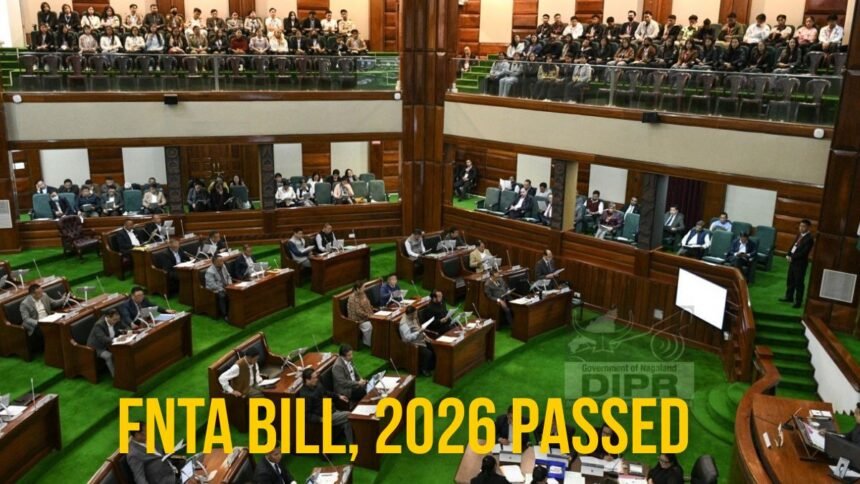
FNTA Bill Nagaland Assembly has marked a major constitutional and administrative development after the Nagaland Legislative Assembly unanimously passed the revised Frontier Nagaland Territorial Authority Bill, 2026, on September 3. The legislation seeks to establish a special territorial authority for six districts in Eastern Nagaland. The passage followed months of consultations involving the state government, the Centre and the Eastern Nagaland Peoples’ Organisation (ENPO).
Mizoram Areca Nut Seizure: 12,000 Kg Consignment Worth ₹1.32 Crore Recovered
FNTA Bill Nagaland Assembly Marks Major Legislative Milestone
The passage of the revised FNTA Bill Nagaland Assembly marks a major legislative step toward establishing the Frontier Nagaland Territorial Authority. The Nagaland Legislative Assembly considered the revised legislation during the second day of the Ninth Session of the 14th Assembly in Kohima.
Moreover, the February 5, 2026, Memorandum of Agreement between the Government of India, the Government of Nagaland and the Eastern Nagaland Peoples’ Organisation provided the framework for creating the FNTA through special legislation.
The legislative process, however, faced constitutional questions earlier in the year. The original Bill was introduced on March 26 but was deferred after the Ministry of Home Affairs sought more time to examine issues surrounding the proposed legislative powers of the FNTA.
The Assembly later withdrew that version on September 1. On the same day, the government introduced a revised Bill for consideration during the special session.
Therefore, the September passage followed months of examination and consultations. The revised Bill was subsequently passed unanimously on September 3.
Six Eastern Districts to Come Under FNTA
The proposed FNTA covers six districts: Tuensang, Mon, Longleng, Kiphire, Noklak and Shamator. The legislation provides for the constitution of the authority across these districts.
Furthermore, Chief Minister Neiphiu Rio said the authority would provide an institutional mechanism for addressing developmental concerns in Eastern Nagaland. He linked the region’s development gaps to historical factors, difficult geography and limited state resources.
Consequently, the FNTA is intended to create a decentralised governance structure for the six districts. The February agreement also envisaged democratic and decentralised self-governance at the regional level within Nagaland.
The revised legislation provides for a 62-member authority with legislative, executive, administrative and financial powers over 46 subjects, according to reports on the Bill passed by the Assembly.
Meanwhile, the government has also linked the FNTA framework with development planning. The authority is expected to prepare its own annual plans for departments and subjects under its control within allocated funds.
Rio has also stressed that the arrangement will operate within the constitutional framework. The government has previously stated that the legislation would be prepared in consultation with the Ministry of Home Affairs and in accordance with the Constitution.
Revised Bill Follows Months of Constitutional Review
The route to the September passage was not straightforward. The earlier FNTA Bill reached the Assembly on March 26. However, the Centre requested additional time to examine the constitutional issue surrounding legislative powers for the proposed authority.
Moreover, the ENPO asked the state government to uphold the provisions of the February agreement. The Eastern Nagaland Legislators’ Union also sought greater clarity before the Bill moved forward.
The state government consequently deferred consideration of the original Bill. It later returned the legislation for further examination.
By July, the government had decided to convene a special Assembly session to enact legislation for the FNTA. The government said the revised approach would address the provisions of the agreement while remaining constitutionally sound.
The Assembly then withdrew the March version on September 1. Deputy Chief Minister Yanthungo Patton introduced the revised Bill on the same day. The Speaker scheduled its consideration and passage for September 3.
The September session therefore marked the culmination of the extended legislative process. The Assembly subsequently passed the revised and amended Bill unanimously.
FNTA Bill Nagaland Assembly Opens New Development Framework
The passage creates the legislative basis for a new institutional framework in Eastern Nagaland. The proposed authority will handle specified subjects and departments under the framework established by the legislation.
Additionally, the FNTA is expected to prepare annual plans within allocated funds. The state government has also outlined arrangements for releasing funds according to applicable state and central government norms.
Therefore, implementation will become the next important stage after the Assembly’s legislative action. The authority will require the administrative and financial processes necessary to operationalise the provisions of the law.
The FNTA also carries significance for the relationship between Eastern Nagaland and the state government. Its creation follows the February agreement and seeks to establish a regional governance arrangement within Nagaland.
Furthermore, Minister P. Bashangmongba Chang described the passage as a landmark development and credited the Centre, state government and ENPO for their efforts. Such statements reflect the political and administrative significance attached to the agreement and the legislation.
Consequently, the passage of the revised Bill represents more than the conclusion of a single Assembly proceeding. It begins a new phase focused on establishing the proposed authority and implementing its governance and development framework.
Conclusion
The FNTA Bill Nagaland Assembly passage on September 3 marks a major legislative step toward establishing the Frontier Nagaland Territorial Authority across six Eastern Nagaland districts. The revised Bill followed the withdrawal of the earlier March version and months of constitutional examination and consultation.
The proposed FNTA covers Tuensang, Mon, Longleng, Kiphire, Noklak and Shamator. The revised legislation provides for a 62-member authority with powers over specified subjects.
The next phase will focus on the administrative, financial and legal steps required to operationalise the authority.
FAQs
1. When did the Nagaland Assembly pass the revised FNTA Bill?
The Nagaland Legislative Assembly unanimously passed the revised and amended Frontier Nagaland Territorial Authority Bill, 2026, on September 3, 2026.
2. Which districts will come under the FNTA?
The six districts are Tuensang, Mon, Longleng, Kiphire, Noklak and Shamator.
3. Why was the original FNTA Bill deferred?
The original Bill was deferred after the Ministry of Home Affairs requested additional time to examine constitutional questions concerning the proposed legislative powers of the FNTA. The ENPO and Eastern Nagaland Legislators’ Union also sought further consideration.
4. What is the proposed FNTA intended to do?
The FNTA is intended to provide a decentralised regional governance framework for the six eastern districts. The legislation also provides for specified legislative, executive, administrative and financial powers over identified subjects.
5. Does the FNTA replace the Nagaland government?
No. The proposed authority operates within Nagaland’s constitutional and legal framework. The legislation establishes a regional authority for the six districts rather than replacing the state government.