






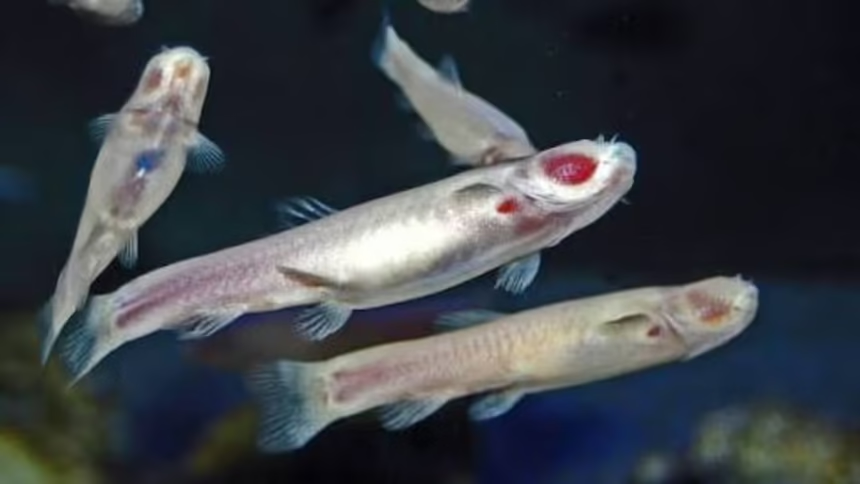
Two previously unknown underground fish species have been discovered in wells in Assam’s Goalpara district, highlighting the region’s rich biodiversity and the need to protect unexplored groundwater ecosystems. Assam Environment and Forests Minister Jayanta Malla Baruah announced the discoveries on October 21, 2026. The newly identified species are Gitchak nakana, a tiny, transparent and blind loach, and Rakthamichthys anchi, a slender, eel-like fish belonging to the swamp eel family.
Researchers examined the specimens with advanced scientific techniques, including micro-computed tomography (micro-CT) scanning. The discoveries offer new insights into underground aquatic life and underline the importance of conserving habitats that remain largely unknown to science.
Read More: Karnataka social media ban now seeks Centre’s backing
Key Facts About the Discovery
- Location: Goalpara district, Assam
- Discovery announced: October 21, 2026
- New species: Gitchak nakana and Rakthamichthys anchi
- First species: A tiny, transparent and blind loach measuring around two centimetres
- Second species: An eel-like fish adapted to underground groundwater environments
- Researcher: Wimarithy K. Marak
- Scientific methods: International research collaboration and micro-CT scanning
- Conservation concern: Pollution and disturbance of underground habitats
Two Unique Fish Species Found Underground
The discovery of Gitchak nakana and Rakthamichthys anchi has expanded scientific knowledge of Assam’s aquatic biodiversity. Both species inhabit underground environments, making their discovery particularly important for researchers studying life in groundwater systems.
Gitchak nakana is a remarkably small fish measuring approximately two centimetres. Its body is transparent, and it has no functional eyesight. The transparency allows its blood and internal organs to remain visible, giving the fish a reddish appearance.
The second species, Rakthamichthys anchi, has a slender, eel-like body. It belongs to the swamp eel family and shows adaptations suited to living in underground groundwater environments.
These characteristics highlight how certain aquatic species survive in habitats with conditions very different from those found in rivers, lakes and ponds.
How Were the Fish Discovered?
According to Environment and Forests Minister Jayanta Malla Baruah, researcher Wimarithy K. Marak collected the specimens during the investigation of underground fish in Goalpara district.
Marak initially shared a photograph of one specimen with her research supervisor. The second species came to light after one of her relatives encountered another underground fish while cleaning a well.
The findings received support from international scientists, who helped examine the specimens using advanced research techniques. Micro-computed tomography, commonly known as micro-CT scanning, allowed scientists to study the fish’s internal structures in detail.
The collaboration helped researchers investigate the specimens and establish their scientific significance.
Why Are These Discoveries Important?
Groundwater ecosystems remain among the least explored environments in biodiversity research. Although these habitats are hidden beneath the surface, they can support highly specialised organisms that have adapted to life in darkness and confined underground spaces.
The discovery of two previously unknown fish species suggests that Assam may contain more undocumented forms of life. Further research could reveal additional species and improve understanding of how underground aquatic ecosystems function.
Moreover, these findings demonstrate why scientists need to investigate wells, groundwater channels and other lesser-explored habitats.
Scientists Warn About Groundwater Pollution
Alongside announcing the discoveries, Baruah emphasised the need to protect underground habitats. He warned that pollution affecting surface water can also reach groundwater systems, potentially threatening species that scientists have only recently begun to identify.
Chemical contamination, waste disposal and other forms of environmental degradation can put fragile underground ecosystems at risk. Because many groundwater species remain poorly understood, environmental damage could affect biodiversity before researchers fully document it.
To reduce the risk of exploitation, researchers have withheld the exact locations where the fish were found. This precaution aims to protect the newly discovered species and their habitats from unnecessary disturbance.
Assam’s Biodiversity and the Northeast
Assam is known for its diverse landscapes, rivers, wetlands and forests. However, the discovery in Goalpara shows that the state’s biodiversity extends beyond its visible natural environments.
Across Northeast India, many ecosystems remain insufficiently explored. Scientific investigations into underground habitats could help identify new species, strengthen conservation planning and improve understanding of the region’s ecological wealth.
Protecting these environments will require continued research, responsible groundwater management and greater awareness of the connections between surface water and underground ecosystems.
Frequently Asked Questions
What new fish species were discovered in Assam?
Researchers identified two previously unknown underground fish species: Gitchak nakana and Rakthamichthys anchi.
Where were the fish discovered?
Both species were found in wells in Goalpara district, Assam.
Who announced the discovery?
Assam Environment and Forests Minister Jayanta Malla Baruah announced the findings on October 21, 2026.
What makes Gitchak nakana unique?
It is a tiny, transparent and blind loach measuring around two centimetres. Its transparent body reveals its blood and internal organs.
Why are the discoveries significant?
They expand scientific knowledge of underground biodiversity and highlight the need to conserve groundwater habitats.
Why have researchers withheld the exact locations?
They have kept the locations confidential to minimise the risk of exploitation and protect the newly discovered species.
The discovery of these two underground fish species marks an important development in Assam’s biodiversity research. It also reinforces the need to protect groundwater ecosystems, which may harbour many more species yet to be documented by science.