





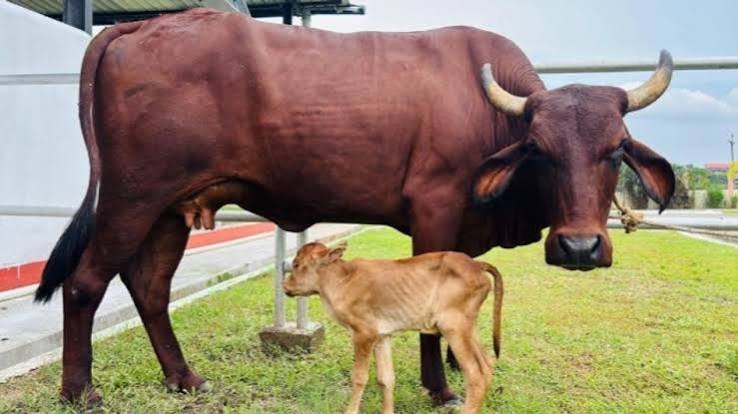
Lakhimi IVF calf has been born at the Assam Veterinary and Fishery University, marking what Assam Chief Minister Himanta Biswa Sarma described on Saturday as the world’s first female calf of the indigenous Lakhimi breed produced through in-vitro fertilisation (IVF). The development is being seen as a major step in livestock biotechnology and indigenous cattle conservation in the state.
The birth took place at the university’s facilities in Khanapara, Guwahati. Sarma announced the achievement in a post on X on August 22, describing it as a historic convergence of Assam’s culture, indigenous livestock resources and scientific innovation.
Lakhimi IVF calf advances indigenous breed conservation
The Lakhimi IVF calf is significant because Lakhimi is an indigenous cattle breed native to Assam. The university lists Lakhimi among the livestock breeds from Assam that have been registered with the ICAR-National Bureau of Animal Genetic Resources.
For Assam, preserving native breeds is important because advanced reproductive technologies can help multiply desirable genetic material. The university has already been working with IVF and embryo-transfer methods as part of the Rashtriya Gokul Mission.
Its research programme has included embryo production involving Lakhimi cattle. The university says the project is aimed not only at improving cattle breeding but also at conserving the Lakhimi breed.
IVF programme gains momentum in Assam
The Lakhimi IVF calf is the latest development in an IVF programme that has already produced important results at the Assam Veterinary and Fishery University. The university’s research information says its Rashtriya Gokul Mission-funded IVF project began with the production and transfer of embryos from several cattle breeds, including Lakhimi.
The Union government’s 2025–26 annual report also records the work of the IVF laboratory at the College of Veterinary Science, Khanapara. It says the laboratory maintained donor animals from several breeds and produced embryos through ovum pick-up, in-vitro fertilisation and embryo culture procedures.
Earlier this year, Assam recorded its first IVF-born calf through embryo-transfer technology. That female calf, from the Gir breed, was born on March 26 at a dairy farm in Sonapur, Kamrup Metropolitan district. Researchers described the achievement as evidence that assisted reproductive technologies could be applied under field conditions in Assam.
Why the Lakhimi breed matters
Lakhimi is among Assam’s recognised indigenous cattle resources. The university’s research programme specifically identifies IVF and embryo-transfer technology as tools for producing elite embryos and supporting conservation of the breed.
Moreover, reproductive technologies can allow selected genetic material to be multiplied more efficiently than through conventional breeding alone. This could support long-term efforts to improve cattle populations while retaining valuable characteristics of indigenous breeds.
However, the practical impact will depend on how successfully such technologies are expanded beyond individual births and integrated into wider livestock programmes.
Potential benefits for Assam’s dairy sector
The birth of the Lakhimi IVF calf could have wider implications for Assam’s dairy sector. According to the chief minister’s announcement, the advancement could open new avenues for indigenous breed conservation, better disease control and improved milk productivity. It may also support higher incomes for farmers dependent on dairy activities.
The technology does not automatically guarantee higher productivity. Instead, it provides researchers with another method to reproduce animals carrying selected genetic traits. Therefore, careful breeding, animal health management and field-level adoption will remain important.
The university’s ongoing programme also includes work on crossbred cattle and other breeds, suggesting that IVF is becoming part of a broader assisted-reproduction effort in Assam.
Assam looks to expand scientific livestock breeding
The Lakhimi IVF calf represents a notable milestone for Assam’s veterinary research programme and its efforts to combine indigenous breed conservation with modern reproductive science.
For the state, the immediate achievement is the successful birth itself. The longer-term test will be whether the technology can help conserve Lakhimi cattle, strengthen breeding programmes and deliver measurable benefits to dairy farmers.
Overall, the development places Assam’s indigenous cattle resources at the centre of a new phase of livestock research. If the programme continues to produce healthy animals and expands responsibly, it could provide a useful model for applying reproductive biotechnology to the conservation of native breeds.