




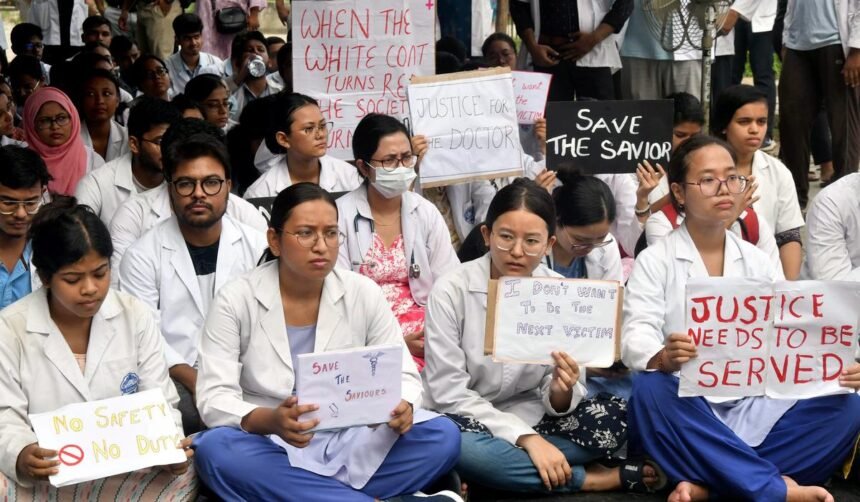
Medical students in Assam staged a demonstration demanding transparent and standardized rural posting guidelines for postgraduate and internship placements. The protest highlights concerns over fairness, clarity in posting criteria, and equitable distribution of healthcare workforce in rural areas. Moreover, students stated that the current system lacks uniformity and often creates uncertainty in deployment processes. The demonstration reflects ongoing concerns regarding medical workforce management in the state.
Meghalaya Micro-Hydro Projects Get Clearance to Provide Power
Demand for Clear and Transparent Posting Policies
Assam medical students stage demonstration seeking transparent rural posting guidelines, urging authorities to introduce a well-defined and merit-based system for rural postings. Consequently, students have called for written and publicly accessible criteria governing placements.
The demonstrators emphasized that rural postings play a crucial role in healthcare delivery across underserved regions. Moreover, they argued that ambiguity in posting procedures can lead to dissatisfaction among trainees. Therefore, clarity and fairness in the system are being demanded.
Student representatives stated that a transparent framework would help build trust between institutions and medical trainees. Furthermore, it would ensure that postings are based on objective parameters. As a result, administrative accountability is being strongly emphasized.
Meanwhile, discussions between student groups and relevant authorities are expected. Consequently, a potential review of existing policies may be considered.
Concerns Over Rural Healthcare Workforce Management
Assam medical students stage demonstration seeking transparent rural posting guidelines amid broader concerns about healthcare staffing in rural areas. Moreover, equitable distribution of doctors remains a key challenge in many districts. Therefore, structured deployment systems are being advocated.
Students highlighted that rural healthcare facilities often face staff shortages. Consequently, improving posting policies is seen as essential for strengthening primary healthcare services. Such measures can improve access to medical care in remote areas.
Furthermore, inconsistencies in posting rules can affect career planning for medical trainees. As a result, students are seeking greater predictability in the system.
Meanwhile, healthcare administrators are under pressure to balance institutional needs and workforce availability. Similarly, policy reforms are being discussed in multiple forums.
Call for Reform and Institutional Accountability
The demonstration by Assam medical students stage demonstration seeking transparent rural posting guidelines reflects broader calls for reform in administrative processes. Moreover, students are advocating for a standardized policy framework. Therefore, institutional accountability is being prioritized.
Protesters suggested the introduction of a centralized posting mechanism. Consequently, this could reduce discretionary decision-making. Such systems are often used to ensure fairness in public service allocations.
Furthermore, students urged authorities to include stakeholder consultation in policy design. As a result, more inclusive decision-making is being encouraged.
Meanwhile, academic institutions are monitoring the situation closely. Similarly, dialogue channels are expected to be opened.
Impact on Healthcare System and Future Expectations
The issue raised by Assam medical students stage demonstration seeking transparent rural posting guidelines has implications for future healthcare staffing in the state. Moreover, efficient posting systems are essential for strengthening rural health infrastructure. Therefore, reforms could have long-term benefits.
Improved transparency in postings may help attract more medical professionals to rural service. Consequently, healthcare delivery in underserved areas could improve. Such outcomes are critical for public health equity.
Furthermore, predictable posting policies can enhance professional satisfaction among trainees. As a result, retention in the public healthcare system may improve.
Meanwhile, authorities may consider policy revisions based on feedback. Similarly, structured reforms could be introduced in phases.
Conclusion
Assam medical students stage demonstration seeking transparent rural posting guidelines, highlighting the need for clarity, fairness, and accountability in medical placement systems. Moreover, the issue underscores the importance of structured workforce management in healthcare.
The demand reflects broader concerns about rural healthcare delivery and administrative transparency. Therefore, policy review and stakeholder engagement are likely to be key steps forward.
As Assam medical students stage demonstration seeking transparent rural posting guidelines, it emphasizes the need for equitable and transparent systems in public healthcare deployment.
FAQs
1. Why are medical students protesting in Assam?
To demand transparent rural posting guidelines.
2. What is their main concern?
Lack of clarity and fairness in posting policies.
3. Why are rural postings important?
They ensure healthcare access in underserved areas.
4. What do students want?
A clear, merit-based, and transparent system.
5. What could be the outcome?
Possible policy review and reforms.