




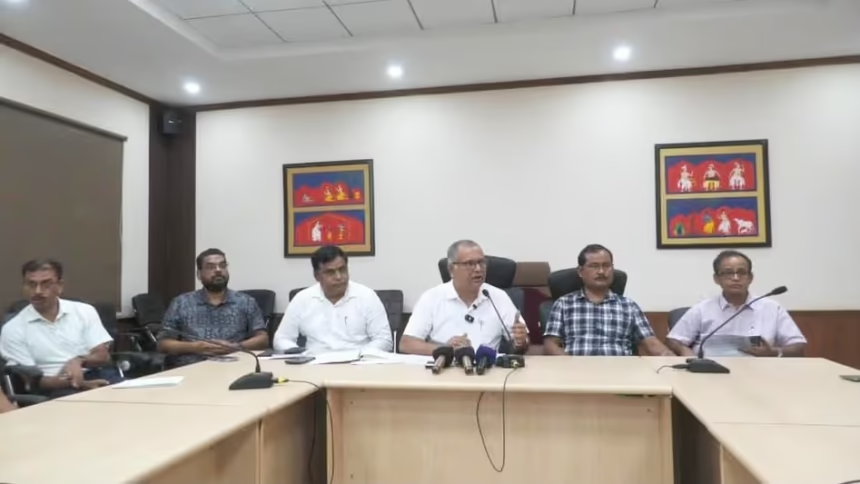
Guwahati: Gauhati University on October 6 rejected what it called “inaccurate and misleading information” regarding the nomination and grievance process for the Post-Graduate Students’ Union (PGSU) Election 2026–27. The university said all decisions were based on official records and established institutional procedures.
It stated that the Returning Officer, Election Tribunal, Appeal Hearing Committee and Grievances Redressal Cell handled the matter. The dispute involves the eligibility of candidates Nayan Akash Bora and Pratik Sharma. The university maintained that no student was targeted and that the candidates were given opportunities to pursue appeals and grievances.
Read More: CJP Assam row intensifies as Himanta raises sharp objections
Key Facts
- Institution: Gauhati University, Assam
- Election: PGSU Election 2026–27
- Date of clarification: October 6, 2026
- Candidates involved: Nayan Akash Bora and Pratik Sharma
- Main issue: Eligibility and simultaneous enrolment in two postgraduate programmes
- Election authorities: Returning Officer, Election Tribunal and Appeal Hearing Committee
University Rejects Allegations of Targeting
Prof Utpal Sarma, Registrar of Gauhati University, said the university had a responsibility to present the complete facts regarding the controversy.
He said the matter was handled through established institutional mechanisms and official records. Sarma also denied allegations that any individual student had been specifically targeted.
The university said concerns regarding the eligibility of Bora and Sharma were brought before the Returning Officer during the scrutiny of nominations on September 23.
The issue was subsequently referred to the Election Tribunal. The tribunal advised that the nominations of the two candidates should not be considered.
Following the recommendation, Election Notification-5/2026 was issued on September 24, recording the cancellation of their nominations.
Appeal Process Followed
The university said Bora subsequently submitted appeals on September 25 and 26.
An Appeal Hearing Committee was constituted on September 26 after obtaining legal opinion. According to the university, Bora was given an opportunity to appear before the committee.
The hearing was also video recorded, and the committee’s findings were communicated to the concerned parties.
A Grievances Redressal Cell was later constituted on September 27 to address the matter through the prescribed institutional process.
Dr Ranjan Kumar Kakati, Secretary, University Classes, said the complete sequence of events should be considered before reaching conclusions about the university’s actions.
He said it was incorrect to claim that the university acted arbitrarily or denied the concerned student an opportunity to present the matter.
Dual Enrolment at Centre of Dispute
According to university records, the central issue involved the student’s simultaneous enrolment in two postgraduate programmes.
The university said the student had initially enrolled in one postgraduate programme under the fee-waiver category but did not clear all papers in the first and second semesters.
Later, the student enrolled in another postgraduate programme, also under the fee-waiver category.
University records also showed that the student continued as a hostel boarder under the earlier programme while being offered hostel accommodation as a first-semester student of the subsequent programme.
The university said the second hostel accommodation was not accepted, while the earlier hostel status remained active.
Officials argued that the issue had implications beyond academic enrolment because fee-waiver benefits and institutional facilities are intended for eligible students.
Kakati said previous practices could not be used to continue arrangements that were inconsistent with prescribed rules.
University Cites Election Rules
Prof S K Singh, Returning Officer for the PGSU Election 2026–27, said the election process was being conducted according to applicable rules and institutional procedures.
He referred to the recommendations of the Lyngdoh Committee, which emphasise transparent and structured student elections, including eligibility checks, nomination scrutiny and grievance-redressal mechanisms.
Singh said that whenever information affecting a candidate’s eligibility is brought before election authorities, it must be examined under the applicable rules.
He also said candidates have the right to seek redress through the prescribed institutional mechanisms.
The university has urged students and other stakeholders to rely on verified information and official records. It also appealed for peace and discipline on the campus.
Gauhati University reiterated that the PGSU Election 2026–27 would proceed according to the applicable rules and that genuine grievances would be considered through the appropriate institutional forums.
Questions and Answers
What is the controversy about?
The dispute concerns the eligibility of two candidates in the PGSU Election 2026–27.
Why were the nominations cancelled?
The Election Tribunal advised that the nominations should not be considered after eligibility concerns involving simultaneous postgraduate enrolment were raised.
Were the candidates allowed to appeal?
Yes. The university said an appeal process was conducted, including a hearing before an Appeal Hearing Committee.
What is the university’s position?
Gauhati University says the process followed established rules and that no individual student was targeted.
When was the clarification issued?
The university issued its clarification on October 6, 2026.
Location Context: Gauhati University is a major higher-education institution in Assam and an important academic centre in Northeast India. The dispute has drawn attention because of its connection to student elections, institutional rules and student grievance mechanisms.
Also Read: NEC projects now mark 14 completed works across Northeast