


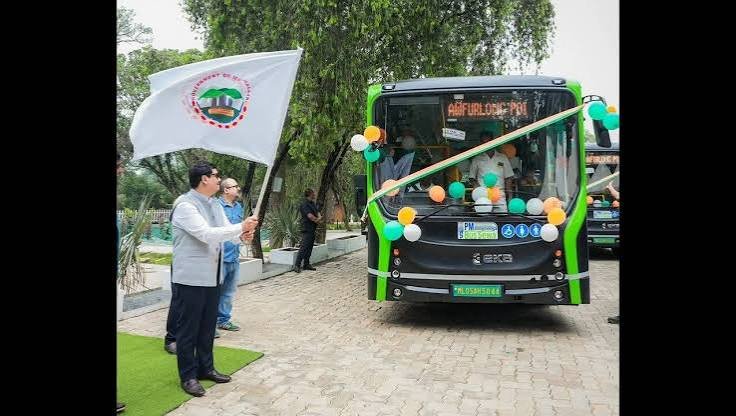
Shillong electric bus inductions have marked a major step in Meghalaya’s effort to modernise urban public transport and reduce dependence on conventional fuel-powered vehicles. Chief Minister Conrad K. Sangma flagged off five electric buses under the PM eBus Sewa Scheme in Shillong on June 9, 2026. The launch followed the larger February rollout of 84 buses, including 55 electric buses, under the state’s “Ka Bos Jong Ngi” public transport initiative.
The electric buses aim to provide cleaner and more reliable mobility while helping address Shillong’s congestion problems. Moreover, the government has linked the programme with wider urban-planning measures, including parking facilities and improved connectivity. The initiative therefore represents both a public-transport expansion and an attempt to reshape how people move through the city.
Gopal Roy Demands Puja Grants for Tripura Clubs
Shillong Electric Bus Inductions Expand Cleaner Public Transport
The June 9 flag-off introduced five electric buses into Shillong’s public transport network under the PM eBus Sewa Scheme. Chief Minister Conrad K. Sangma described the launch as another step toward finding a transport model suited to the city’s particular mobility challenges.
The government has identified public transportation as an important part of its strategy to reduce congestion. Consequently, the electric buses are not being introduced as an isolated environmental project. Instead, authorities are connecting the fleet with broader efforts involving public transport, parking infrastructure and urban development.
The February launch had already established the “Ka Bos Jong Ngi” service under the Urban Affairs Department. At that event, the state flagged off 84 new buses, including 55 electric buses inducted through PM eBus Sewa. The buses included air-conditioning, mobile charging points, real-time tracking and electronic ticketing facilities.
Furthermore, the initial pilot service operated between IIM Shillong and Upper Shillong. The planned service schedule ran from 7 AM to 9 PM, giving commuters an alternative to private vehicles for regular journeys.
Electric Fleet Targets Congestion and Urban Emissions
Shillong faces significant mobility pressure because of increasing traffic and limited road space. Therefore, improving public transport could help reduce the number of private vehicles required for everyday commuting if sufficient passengers shift toward scheduled bus services.
The state government has explicitly connected the electric-bus programme with its objective of decongesting Shillong. During the June launch, the Chief Minister said the ultimate goal was to encourage people to use public transportation instead of relying heavily on private vehicles.
Electric buses also produce no tailpipe emissions while operating. Consequently, replacing some conventional bus journeys with electric services can reduce direct exhaust emissions along urban routes. However, the overall environmental benefit also depends on factors such as electricity generation, passenger occupancy, route efficiency and fleet utilisation.
Meanwhile, the government is pursuing complementary infrastructure projects. New parking facilities are being developed in different parts of Shillong, while the planned administrative city at Mawdiangdiang is expected to help reduce pressure on the existing urban core.
The government has also been pursuing wider urban transformation projects. Its 2026-27 Budget highlighted redevelopment initiatives in Shillong, including Barik Point, Ward’s Lake, Polo Riverfront and multi-level parking projects. Such measures can work alongside public transport improvements by creating a more integrated urban mobility system.
Ka Bos Jong Ngi Builds a Wider Bus Network
The electric buses form part of a broader public transport model rather than operating as a separate standalone fleet. The “Ka Bos Jong Ngi” initiative was formally introduced with the February 2026 launch, and authorities have continued expanding bus services during the year.
Moreover, the state has experimented with different mobility solutions before and during the electric-bus rollout. Officials have indicated that the programme is intended to create a public transport system that responds more effectively to Shillong’s travel patterns.
The government has also expanded conventional bus services under the same broader public-transport push. In July, an additional 14 air-conditioned diesel buses were reported as being introduced for Shillong’s network, including a route between the Inter State Bus Terminus at Mawlai-Mawiong and Lad Smit.
This combination shows that Meghalaya is currently using multiple vehicle types while building its urban transport network. Therefore, the electric buses should not be viewed as an immediate replacement for the entire conventional fleet. Instead, they represent an important component of a gradually expanding public transport system.
The state’s wider Chief Minister’s Regional Transport Scheme also seeks to improve bus connectivity between Block Headquarters and District Headquarters. Although that scheme primarily addresses regional connectivity rather than Shillong’s electric fleet, it reflects the government’s broader emphasis on bus-based public transportation.
Additionally, the government has sought to make public transport more accessible and technology-enabled. Features such as electronic ticketing and real-time tracking can help passengers understand service availability while allowing operators to monitor fleet performance.
Future Fleet Expansion Could Strengthen Shillong Mobility
The initial electric-bus rollout is only one stage of Meghalaya’s longer-term urban mobility plans. The government has indicated that additional electric buses will enter service, while officials have discussed expanding the network across several important routes.
The June 2026 launch also included an indication from Urban Affairs officials that four major routes had been identified for electric-bus operations. Officials expressed the expectation that Shillong could have a combined fleet of around 150 diesel and electric buses operating on regular schedules within six months.
If implemented effectively, a larger scheduled fleet could provide commuters with more dependable alternatives to private vehicles. Furthermore, higher passenger volumes could make public transport more efficient and help reduce the number of individual vehicle journeys.
Accessibility is another important consideration. Reports on the electric buses describe features including wheelchair spaces and foldable ramps, alongside air-conditioning and electronic ticketing. These facilities can make public transport more convenient for a wider range of passengers.
However, fleet expansion will require adequate charging infrastructure, maintenance facilities, trained personnel and reliable scheduling. Consequently, the long-term success of the electric-bus programme will depend not only on the number of buses purchased but also on how consistently the services operate.
Shillong’s geography and road conditions also make route planning important. Electric buses must operate efficiently across the city’s terrain and traffic conditions. Therefore, monitoring vehicle performance and passenger demand can help authorities adjust routes and schedules as the network expands.
Conclusion
Shillong electric bus inductions represent an important development in Meghalaya’s effort to create cleaner and more dependable urban transportation. The June introduction of five electric buses followed the February rollout of a larger fleet under the PM eBus Sewa Scheme and the “Ka Bos Jong Ngi” initiative.
Moreover, the programme forms part of a wider strategy to tackle congestion, encourage public transport use and improve urban mobility. Electric buses can reduce direct tailpipe emissions, while features such as GPS tracking and e-ticketing can improve the passenger experience.
The next stage will depend on network expansion, charging infrastructure, maintenance and consistent service. If these elements develop alongside the fleet, Shillong’s electric-bus programme could become an important part of the city’s long-term transition toward more sustainable public transportation.
FAQs
What are the Shillong electric bus inductions?
They refer to Meghalaya’s introduction of electric buses into Shillong’s public transport system under the PM eBus Sewa Scheme. Five electric buses were flagged off in June 2026.
How many electric buses were initially sanctioned for Shillong?
The February 2026 rollout included 55 electric buses under the PM eBus Sewa Scheme, while five were formally flagged off in the June phase.
What is Ka Bos Jong Ngi?
Ka Bos Jong Ngi is Meghalaya’s urban public transport initiative under the Urban Affairs Department. It combines bus services with technology such as real-time tracking and electronic ticketing.
How can electric buses help Shillong?
Electric buses can provide zero-tailpipe-emission transportation while encouraging commuters to shift from private vehicles to public transport. They can therefore contribute to cleaner urban mobility when operated efficiently.
Will Shillong receive more electric buses?
The government has planned further expansion of the electric-bus network. Officials have also identified additional routes and discussed building a substantially larger combined electric and conventional bus fleet.