



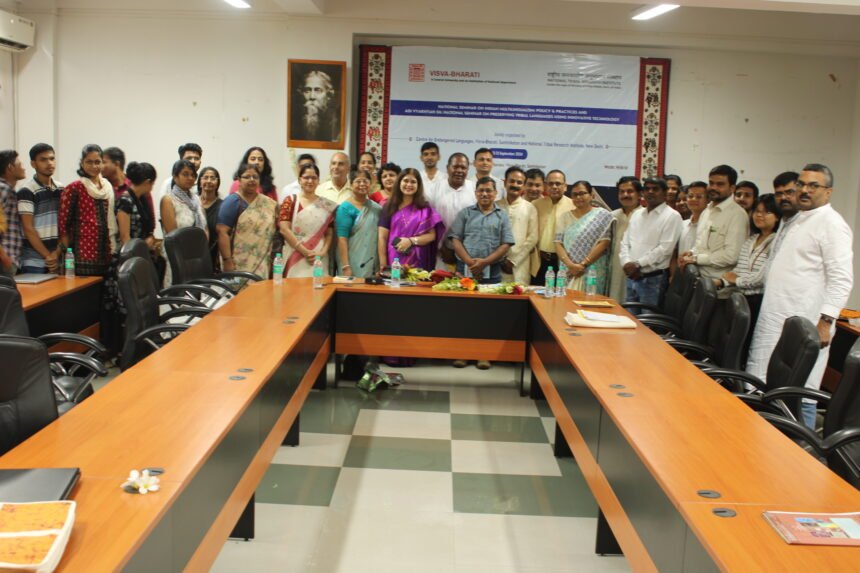
Guwahati University has hosted a national seminar focused on tribal languages and historical preservation, bringing together scholars, researchers, and policymakers from across the country. The event highlights the importance of safeguarding indigenous languages and documenting tribal histories in the face of rapid cultural change. Moreover, participants emphasized the need for academic and institutional support to preserve linguistic diversity. The seminar reflects a growing national interest in protecting intangible cultural heritage.
Manipur Handloom Weavers Get Direct Financial Assistance Through a State Cooperative Bank Rollout
Security Forces Rescue 115 Human Trafficking Victims From Assam; 9 Traffickers Arrested in Bihar
Academic Platform Highlights Tribal Linguistic Diversity
Guwahati University hosts national seminar on tribal languages and historical preservation to promote research on India’s rich linguistic heritage. Consequently, discussions centered on the urgency of documenting endangered tribal languages.
Experts noted that many tribal languages are at risk of extinction due to modernization and migration. Moreover, the loss of language often leads to the erosion of cultural identity. Therefore, preserving linguistic diversity has become a critical academic priority.
Researchers presented papers on phonetics, grammar, and oral traditions of various tribal communities. Furthermore, comparative studies were conducted to analyze similarities across regional dialects. As a result, the seminar provided a comprehensive academic platform for knowledge exchange.
Meanwhile, students and young researchers actively participated in discussions. Consequently, awareness about tribal language preservation was significantly strengthened.
Focus on Documenting Oral Histories and Cultural Traditions
The Guwahati University hosts national seminar on tribal languages and historical preservation with a strong focus on documenting oral histories. Moreover, tribal communities often rely on oral traditions to pass down historical knowledge. Therefore, recording these narratives is essential for cultural continuity.
Experts emphasized the importance of field research in remote tribal areas. Consequently, ethnographic studies are being encouraged to preserve storytelling traditions. Such documentation helps maintain historical accuracy.
Furthermore, archival initiatives are being discussed to store linguistic and cultural data digitally. As a result, future generations can access preserved knowledge more easily.
Meanwhile, collaborations with tribal elders were highlighted as crucial for authentic documentation. Similarly, community participation was encouraged in research efforts.
Policy and Institutional Support for Preservation Efforts
Guwahati University hosts national seminar on tribal languages and historical preservation while emphasizing the need for stronger policy support. Moreover, institutional backing is essential for sustained research and preservation efforts. Therefore, academic institutions are playing a central role.
Government representatives highlighted ongoing cultural preservation schemes. Consequently, funding support for linguistic research is being expanded. Such initiatives strengthen academic infrastructure.
Furthermore, universities are being encouraged to establish dedicated tribal studies departments. As a result, structured research programs can be developed.
Meanwhile, digital libraries and language repositories are being proposed. Similarly, inter-university collaboration is being promoted.
Strengthening Cultural Identity Through Education
The seminar underscored the role of education in preserving tribal identity and language heritage. Moreover, integrating tribal knowledge into academic curricula can enhance cultural understanding. Therefore, educational reforms are being discussed.
Schools and universities are being encouraged to include regional languages in their teaching modules. Consequently, students gain better awareness of indigenous cultures. Such inclusion strengthens cultural identity.
Furthermore, workshops and training programs for teachers were proposed. As a result, language preservation can be supported at the grassroots level.
Meanwhile, cultural festivals and academic exchanges are being planned. Similarly, student research projects are being promoted.
Conclusion
Guwahati University hosts national seminar on tribal languages and historical preservation, highlighting the urgent need to protect India’s linguistic and cultural diversity. Moreover, the event fosters academic collaboration and policy discussions.
The seminar emphasizes documentation, education, and institutional support for preserving tribal heritage. Therefore, it contributes to long-term cultural sustainability.
As Guwahati University hosts national seminar on tribal languages and historical preservation, it reinforces the importance of safeguarding indigenous knowledge systems for future generations.
FAQs
1. What event was hosted at Guwahati University?
A national seminar on tribal languages and historical preservation.
2. Who participated in the seminar?
Scholars, researchers, and policymakers.
3. What was the main focus?
Preserving tribal languages and cultural heritage.
4. Why is this important?
Many tribal languages are at risk of extinction.
5. What methods were discussed?
Documentation, research, and digital archiving.