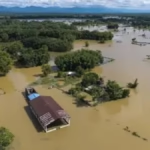






Assam Chief Minister Himanta Biswa Sarma has raised concerns over alleged illegal hill mining and deforestation along the Nagaland border, linking the activities to severe runoff and worsening flood conditions in Assam’s valley areas. The state government has indicated that it plans to take the matter up directly with the Central Government.
Congress Issues Three-Line Whip as FCRA Bill Debate Looms in Parliament
The issue has gained attention as Assam continues to deal with the consequences of severe flooding across several districts. Moreover, authorities have increasingly focused on factors that can accelerate runoff, soil erosion, and downstream flooding.
Assam’s concerns centre on unregulated extraction and vegetation loss in hill areas near the interstate boundary. However, the state’s claim that these activities represent a key catalyst for the flooding remains an official assessment and should not be treated as the sole established cause without detailed environmental and hydrological evidence.
Assam Raises Border Mining Concerns
The Assam government has identified alleged illegal hill mining and deforestation near the Nagaland border as a growing environmental concern.
Chief Minister Himanta Biswa Sarma has said the issue requires attention at the Central level. Furthermore, the state wants authorities to examine how activities in upstream hill areas may influence water flow into Assam.
The concern comes during a period of severe flooding, when large volumes of runoff have affected downstream communities.
However, establishing a direct connection between specific mining activities and individual flood events requires scientific assessment.
Illegal Hill Mining Under Scrutiny
Hill mining can alter natural landscapes and drainage patterns.
When extraction removes soil and rock from slopes, it can disturb the terrain and increase erosion. Additionally, poorly managed mining sites may contribute sediment to streams and waterways during heavy rainfall.
These changes can affect downstream water systems.
However, the scale of any impact depends on factors such as the location of mining, rainfall intensity, slope characteristics, vegetation cover, and existing drainage networks.
Deforestation Adds Environmental Pressure
The Assam government has also highlighted alleged deforestation in areas along the Nagaland border.
Vegetation plays an important role in slowing surface runoff and stabilising soil. Moreover, the removal of trees and other vegetation can increase erosion and allow rainwater to move more rapidly across exposed slopes.
During periods of intense rainfall, these effects can become more significant.
However, deforestation represents only one factor that can influence flood severity.
Severe Runoff Affects Assam Valleys
Assam’s valley regions can receive substantial water from surrounding hill areas during intense rainfall.
Rapid runoff can increase water levels in rivers and low-lying areas. Furthermore, sediment carried downstream can reduce drainage efficiency and contribute to the accumulation of material in waterways.
The state government believes activities along the Nagaland border may be worsening these conditions.
However, rainfall, river levels, embankment conditions, drainage capacity, land use, and upstream catchment conditions can all influence flooding.
Sarma Plans to Raise Issue With Centre
Chief Minister Sarma has indicated that Assam will take the border-related environmental concerns up with the Central Government.
Such intervention could bring together agencies responsible for environmental regulation, forests, mining, water resources, and interstate coordination. Moreover, Central involvement could help facilitate discussions between Assam and Nagaland.
The issue therefore extends beyond ordinary flood relief.
However, the precise mechanism and timeline for any Central intervention should depend on official communications from the concerned governments.
Interstate Coordination Becomes Important
The location of the alleged activities makes interstate coordination particularly important.
Environmental problems in an upstream area can affect communities downstream, even when the two locations fall under different state administrations. Therefore, Assam and Nagaland may need coordinated monitoring of hill areas, drainage systems, forest cover, and mining activity.
Joint assessments could help establish the scale of the problem.
Furthermore, coordinated enforcement could make it easier to address activities that cross administrative boundaries.
Environmental Damage Can Increase Erosion
Unregulated extraction can expose soil and rock to heavy rainfall.
Once slopes lose protective vegetation, rainfall can wash loose material into nearby streams. Additionally, mining can alter natural contours and create unstable sections of hillsides.
The resulting sediment can travel downstream during major rainfall events.
However, authorities need field studies to determine whether such processes have materially increased flood severity in specific Assam locations.
Flood Management Requires Multiple Measures
Addressing flooding requires more than tackling one suspected source.
Authorities must also manage river channels, drainage systems, embankments, wetlands, catchment areas, and urban development. Moreover, improved early-warning systems and evacuation planning can reduce risks to communities during extreme rainfall.
Therefore, action against illegal mining and deforestation would represent one component of a broader flood-management strategy.
Need for Scientific Assessment
Environmental allegations involving interstate mining require reliable evidence.
Hydrological studies can examine rainfall patterns, runoff rates, sediment loads, river capacity, and changes in land cover. Furthermore, satellite imagery and field inspections can help authorities identify changes in vegetation and mining activity.
Such evidence can establish whether suspected activities have significantly altered local drainage patterns.
However, scientific findings should guide enforcement decisions rather than assumptions based solely on the timing of floods.
Nagaland Border Areas Face Monitoring Questions
The allegations also raise questions about monitoring and enforcement in border areas.
Remote hill regions can present difficulties for regulators because of challenging terrain and limited administrative access. Additionally, informal extraction activities can be difficult to detect without regular inspections and satellite monitoring.
Strengthening surveillance could help authorities identify unauthorised activities earlier.
However, effective enforcement would require coordination between state departments and relevant Central agencies.
Political Debate Likely to Intensify
The border-mining issue could become another political point of debate as Assam recovers from severe flooding.
The government can point to environmental degradation as one factor requiring stronger action, while opposition parties may demand evidence and accountability for flood-management decisions. Moreover, interstate concerns could add another dimension to the political discussion.
The debate could therefore continue alongside relief and rehabilitation efforts.
However, political arguments should remain separate from the scientific assessment of flood causes.
Local Communities Face the Consequences
Residents living downstream ultimately bear the consequences of severe flooding and environmental degradation.
Floodwaters can damage homes, farmland, roads, and livelihoods. Furthermore, heavy sediment deposition can make recovery more difficult by covering agricultural land and blocking drainage channels.
Communities therefore have a direct interest in preventing activities that could increase environmental vulnerability.
However, authorities must also ensure that any enforcement action follows environmental and legal procedures.
Long-Term Catchment Management Needed
The latest controversy highlights the importance of managing entire river catchments rather than focusing only on downstream areas.
Catchment management can include protecting forests, controlling erosion, monitoring mining, restoring degraded slopes, and maintaining natural drainage channels. Additionally, interstate coordination can help authorities address environmental risks that do not stop at state boundaries.
Such measures can strengthen long-term flood resilience.
However, implementation requires sustained monitoring rather than short-term action during flood emergencies.
What Happens Next?
The immediate focus will likely remain on Assam’s flood recovery and the government’s efforts to raise the border-mining issue with the Centre.
Authorities could conduct inspections, review mining activity, and assess changes in forest cover. Moreover, scientific agencies may examine whether altered land use has contributed to increased runoff.
If officials establish violations, appropriate enforcement could follow under applicable environmental and mining laws.
However, the outcome will depend on the evidence collected and the response from the authorities concerned.
Conclusion
The Assam government has intensified scrutiny of alleged illegal hill mining and deforestation along the Nagaland border, with Chief Minister Himanta Biswa Sarma indicating that he will raise the issue with the Central Government. Assam has linked these activities to increased runoff and worsening flood conditions in downstream valley areas.
Moreover, mining and vegetation loss can affect erosion and surface runoff, particularly during intense rainfall. At the same time, flooding results from multiple interacting factors, including rainfall, river conditions, drainage capacity, land use, and catchment characteristics.
Overall, a detailed scientific assessment will be crucial in determining how much border-area mining and deforestation contribute to Assam’s flood vulnerability. Interstate cooperation, environmental monitoring, and stronger enforcement could become important parts of a longer-term strategy to protect downstream communities.
FAQs
1. What issue has Himanta Biswa Sarma raised?
The Assam Chief Minister has raised concerns over alleged illegal hill mining and deforestation along the Nagaland border and their potential effect on runoff and flooding.
2. Why can hill mining affect flooding?
Mining can disturb slopes, remove vegetation, increase soil erosion, and alter natural drainage patterns, potentially increasing sediment and runoff during heavy rainfall.
3. Is mining the only cause of Assam’s flooding?
No. Flood severity can depend on several factors, including rainfall intensity, river levels, drainage capacity, land use, embankments, and upstream catchment conditions.
4. Why is the Centre involved?
Because the issue concerns an interstate border and potentially involves environmental, mining, forest, and water-management responsibilities across different jurisdictions.
5. What could happen next?
Authorities could conduct environmental and mining inspections, assess land-use changes, coordinate with Nagaland, and examine scientific evidence on the relationship between upstream activities and downstream flooding.