







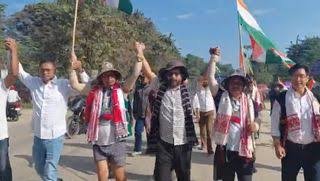
The Siang project protest in Arunachal Pradesh has gained momentum after demonstrators crossed into Assam’s Dhemaji district, demanding the cancellation of the proposed 11,200-megawatt Siang Upper Multipurpose Project (SUMP). The march reached Jonai on November 6, drawing support from several political and social organisations in Assam.
Led by the Adi Galo Welfare Society (AGWS), the protest movement seeks government action on several demands, including the release of detained individuals, withdrawal of police cases and removal of security forces from affected villages. The development signals growing opposition to the proposed mega dam beyond Arunachal Pradesh.
Siang Project Protest March Enters Assam
The protest march began on November 4 from Geku village in Arunachal Pradesh’s Upper Siang district. Participants travelled through different parts of the state before reaching Ruksin and crossing the border into Assam.
On November 6, the protesters arrived in Jonai, located in Dhemaji district. Several organisations welcomed the marchers and expressed solidarity with their opposition to the proposed hydropower project.
Among those supporting the movement were the Asom Jatiyatabadi Yuva Chatra Parishad (AJYCP), Assam Jatiya Parishad (AJP) and Krishak Mukti Sangram Samiti.
The participation of these organisations has brought additional attention to the agitation. Moreover, their support highlights concerns about the possible environmental and social consequences of a major infrastructure project on the Siang River.
The Adi Galo Welfare Society is leading the march to bring the protesters’ demands before the authorities and seek a peaceful resolution to the ongoing dispute.
Protesters Demand Cancellation of Siang Project
The central demand of the Siang project protest is the complete cancellation of the proposed 11,200-MW Siang Upper Multipurpose Project.
However, the protesters have also raised several immediate concerns linked to the government’s response to the anti-dam movement.
Their demands include:
- Immediate release of individuals detained during the anti-dam agitation.
- Withdrawal of FIRs registered against 48 youths.
- Removal of security forces from villages affected by the proposed project.
- Revocation of suspension orders issued against government employees and other individuals.
- Initiation of peaceful dialogue between the government and community representatives.
The protesters argue that authorities must address these concerns before proceeding with activities connected to the proposed project.
Additionally, they have called for greater attention to the rights and interests of indigenous communities living in the Siang Valley.
Assam Organisations Extend Support to Protesters
The arrival of the marchers in Jonai received support from several organisations in Assam. Their representatives criticised the proposed mega dam and questioned its possible impact on local communities.
AJP general secretary Chittaranjan Basumatary expressed solidarity with the protesters. He raised concerns about the environmental impact of the project and its potential consequences for traditional livelihoods and indigenous culture.
Basumatary also questioned the rationale behind pursuing such a large project in the Siang Valley. He referred to China’s proposed 60,000-MW hydropower project at Medog and argued that regional development should not come at the expense of local communities.
He stressed that the concerns and consent of affected residents must receive serious consideration.
Meanwhile, AJYCP central finance secretary Gyan Sharma assured the protesters that his organisation would support the Adi community’s movement against the proposed dam.
The organisations also indicated their willingness to stand with the affected communities as the agitation continues.
Environmental and Community Concerns Drive Opposition
The proposed Siang Upper Multipurpose Project has faced resistance from sections of the indigenous Adi community, particularly residents of areas that could experience significant changes if the project advances.
Concerns include the possible submergence of villages, displacement of families and loss of agricultural land, forests and ancestral properties.
Furthermore, residents fear that large-scale construction could affect the Siang River, which holds considerable cultural, economic and social importance for communities living along its banks.
For many indigenous families, the river represents more than a source of water. It remains closely connected to their traditions, livelihoods and cultural identity.
Consequently, protesters argue that any major development initiative must involve meaningful consultation with affected communities.
They have also questioned whether the potential economic benefits would justify the long-term environmental and social costs.
Government Faces Pressure for Dialogue
The expanding Siang project protest comes amid heightened tensions between protesters and authorities in Arunachal Pradesh.
Chief Minister Pema Khandu recently stated that neither the state government nor the Centre had taken a final decision regarding construction of the proposed project.
He explained that the government was currently considering a preliminary feasibility assessment. He also assured residents that their concerns would receive attention through dialogue, transparency and public consultation.
However, protesters continue to demand concrete action on the detention of activists, security deployment and suspension orders.
The march into Assam has added another dimension to the movement by attracting support from organisations outside the proposed project area.
The coming days will be important for determining whether the expanding agitation leads to meaningful discussions with the authorities. For now, protesters remain firm on their demand to scrap the 11,200-MW project and address the concerns of affected communities.
Meghalaya CM Conrad Sangma Inaugurates ₹20 Crore Mawlasnai-Kdohhati Road