


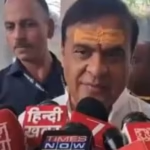

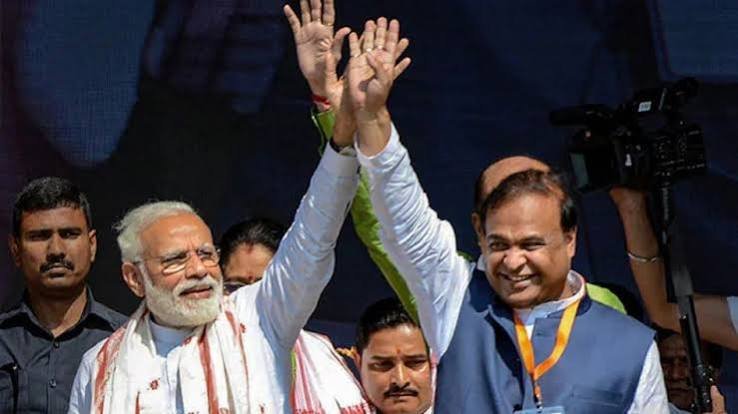
Modi popularity remains unmatched and is likely to stay strong in the future, Assam Chief Minister Himanta Biswa Sarma said while commenting on Prime Minister Narendra Modi’s standing in Indian politics.
Sarma made the remarks while speaking to reporters on Friday, August 28, amid discussion over the Prime Minister’s popularity and the latest political survey findings. He said Modi’s appeal has remained consistent over time and suggested that it would continue in the years ahead.
Himanta backs Modi’s continued appeal
Sarma said there was no comparison with Modi’s popularity as a political leader. According to him, the Prime Minister has remained popular in the past, continues to enjoy strong public support and is likely to retain that position in the future.
The Assam Chief Minister’s remarks underline the importance the BJP continues to attach to Modi’s national appeal. His statement also comes after the BJP and its allies secured another electoral success in Assam in 2026.
The comments reflect Sarma’s broader view that Modi remains a central figure in Indian politics. However, political support can vary across states and among different sections of voters.
Modi popularity figures cited in survey
Sarma’s comments came in the context of the India Today-CVoter Mood of the Nation survey. A report published on August 28 said the February 2026 survey found 55 per cent of respondents choosing Modi as their preferred candidate for prime minister.
Such surveys measure public opinion at a particular point in time. Therefore, their findings do not necessarily predict future election results.
Still, the figures provide an indication of Modi’s continued national visibility. The Prime Minister has remained a dominant figure in electoral campaigns since the BJP came to power at the Centre in 2014.
BJP’s political strategy remains Modi-focused
Modi’s popularity has played an important role in the BJP’s election campaigns over the past decade. The party has frequently highlighted his leadership, government schemes and development agenda during national and state elections.
At the same time, recent electoral outcomes have also highlighted the importance of state-level leadership. In Assam, Sarma played a prominent role in the BJP-led campaign and helped the alliance secure a third consecutive term in the state.
A May 2026 report said BJP leaders attributed the Assam victory to a combination of Modi’s popularity and Sarma’s leadership.
State leadership adds another dimension
While Modi remains the BJP’s most prominent national face, the party has increasingly relied on influential regional leaders to strengthen its organisation in individual states.
Sarma is among the leaders who have developed a strong political profile in Assam. His government has focused on welfare schemes, infrastructure, law and order and other state-specific issues.
The BJP’s success in Assam therefore reflects both national and regional factors. Moreover, analysts have noted that the party’s organisational strength and state-level leadership can influence electoral outcomes alongside the Prime Minister’s appeal.
Modi popularity remains a political talking point
The debate over Modi popularity is likely to remain important as political parties prepare for future electoral contests. Supporters point to his long tenure, national profile and repeated electoral victories as evidence of sustained public appeal.
However, opposition parties continue to challenge the BJP on issues including governance, employment, the economy and social concerns. Public opinion can also shift between elections, making long-term predictions difficult.
For now, Sarma has made his position clear. He believes Modi’s popularity stands apart from that of other political leaders and will remain strong in the years ahead. His assessment adds to the continuing political discussion around Modi’s influence and the BJP’s national strategy.
Manipur Kangpokpi Ambush: Four Naga Civilians Reportedly Killed on IT Road