





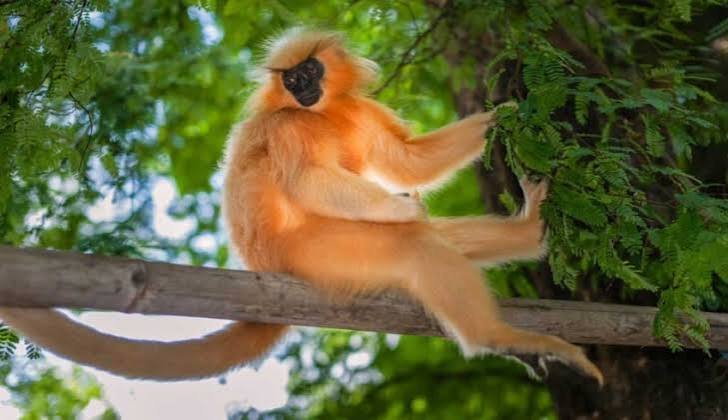
Kakoijana golden langur conservation is increasingly linked with local livelihoods, as women from villages around the forest explore skills that can support both families and wildlife.
In August 2025, the Wildlife Trust of India (WTI), with support from Royal Enfield Social Mission, took 20 women from fringe villages of Kakoijana on a two-day exposure trip focused on sustainable livelihoods and conservation. The programme showed how participation can connect income opportunities with protection of the primate.
Women learn skills linked to conservation
The initiative took participants to Rangapani in Assam’s Baksa district, as well as Nganglam in Bhutan and conservation-linked enterprises. The visit covered forest protection, women-led businesses and community-based ecotourism.
At Zankla Studio, the women received practical exposure to eco-friendly enterprise. Artisans demonstrated embroidery using golden langur motifs on cotton fabric and helped participants make replicas of the species.
WTI also provided each participant with an embroidery kit, a golden langur plush toy and a tote bag featuring golden langur motifs. The materials encouraged continued practice and linked conservation messages with livelihood activities.
Kakoijana golden langur faces habitat pressure
Kakoijana Reserve Forest is located near Abhayapuri in Bongaigaon district. The Assam government describes the forest as covering about 17.24 square kilometres and identifies it as habitat for around 450 endangered golden langurs.
The species, scientifically known as Trachypithecus geei, has a restricted range in western Assam and southern Bhutan. It is listed as endangered and remains vulnerable to habitat fragmentation, road accidents, electrocution and human-wildlife conflict.
A 2020 study based on a 2017 survey recorded 489 golden langurs in 45 troops across the forest and surrounding pastoral areas. Some troops also used village-edge habitats, showing why conservation cannot stop at the forest boundary.
Kakoijana golden langur conservation grows locally
The story of Kakoijana golden langur conservation is closely tied to community involvement. Earlier conservation work brought local organisations and villagers together to address illegal timber cutting, forest degradation and threats to wildlife.
Research published in Oryx documented the development of Forest Committees and Self Help Groups around Kakoijana and other forests. More than 40 Self Help Groups were formed across several areas from 2003, with female groups showing strong continuity.
These groups supported micro-enterprises and helped reduce economic dependence on activities such as logging. Community forest groups also took part in reforestation and forest protection, creating a model in which conservation and livelihoods could reinforce each other.
Why women matter in the model
Women’s participation is particularly important because livelihood programmes can give households alternatives while building local support for forest protection. In the Kakoijana area, earlier community conservation work found that women’s Self Help Groups were among the more sustained groups.
The exposure programme builds on that approach. Rather than treating conservation as separate from village economies, it introduces practical skills and ideas that can make wildlife protection part of local development.
Restoring habitat remains essential
Livelihood support alone cannot secure the future of the Kakoijana golden langur. The forest is an isolated habitat surrounded by human settlements, and scientific research has recorded degraded and scrub areas within the landscape.
A recent conservation case study associated with the GEF Small Grants Programme reported restoration work involving more than 9,000 fruit-bearing saplings, including fig, jackfruit, mango and wild guava, across forest and community land. Such planting aims to improve food availability and strengthen habitat connections for langurs.
The Assam government lists Kakoijana Reserve Forest as a significant wildlife site. Local conservation groups have long supported stronger protection for the area, including its proposed upgrade to a wildlife sanctuary.
Kakoijana golden langur protection needs local support
The experience of Kakoijana shows that conservation can become stronger when people living beside forests have a stake in their protection. For women, livelihood skills can offer an additional route to participate in that process.
The recent programme does not by itself resolve the threats facing the species. However, it adds a practical community dimension to the long-running effort to protect the forest and its wildlife.
Ultimately, the future of the Kakoijana golden langur will depend on healthy habitat, sustained community action and effective protection. Linking women’s economic opportunities with conservation could help make that effort more durable.