




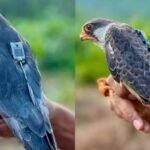


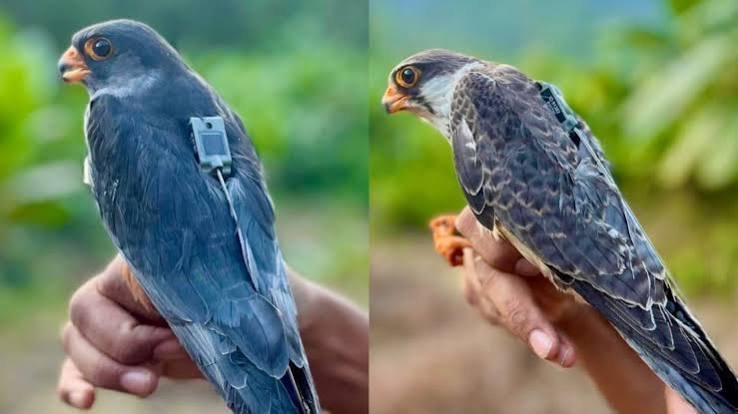
Amur falcons Apapang and Alang have returned to the migration spotlight as the seasonal movement of these remarkable birds brings them back towards Manipur. Their journey across 23 countries highlights the importance of satellite tracking in understanding long-distance bird migration.
The two satellite-tagged birds are part of a conservation project led by the Manipur Forest Department in collaboration with the Wildlife Institute of India (WII). Their movements provide valuable information about migration routes, stopover sites and the challenges faced by migratory birds.
Amur falcons return to Manipur during migration season
Amur falcons have started arriving in Manipur’s Tamenglong district as part of their annual southbound migration. Residents of Guangram village reported the first sightings on October 11, according to reports published earlier this month.
Forest officials confirmed that the birds were arriving in small groups. The seasonal return draws attention to Tamenglong’s importance as a resting and feeding ground for these migratory raptors.
Meanwhile, Apapang and Alang began their southward journey from their breeding grounds in northeastern China on October 10. Wildlife Institute of India scientist Dr Suresh Kumar has been monitoring their movements through satellite tracking.
Reports published in mid-October said the pair was expected to reach Manipur around October 20. The latest confirmed reports available for this article establish their departure and expected arrival, but do not independently confirm their precise current locations.
Amur falcons cross countries on an extraordinary journey
Amur falcons (Falco amurensis) are among the most remarkable migratory birds of prey. They travel between breeding grounds in northeastern Asia and wintering areas in southern Africa, covering approximately 20,000 kilometres during their annual migration.
Their route takes them through several countries and across challenging geographical barriers. During the southbound journey, they pass through parts of China, Laos, Vietnam and Myanmar before reaching Northeast India.
From the region, the birds continue towards Africa, crossing the Arabian Sea on their long-distance flight. Satellite tracking helps researchers identify their movements across different landscapes and understand how they navigate such demanding journeys.
Moreover, the birds’ migration demonstrates the importance of protecting habitats across national boundaries. Their survival depends on suitable feeding grounds and safe resting places throughout their route.
Amur falcons tracking project reveals migration patterns
The Manipur Amur Falcon Tracking Project helps scientists study these birds through satellite transmitters. The Manipur Forest Department and the Wildlife Institute of India work together to monitor their movements and gather information about their migration.
In November 2025, researchers tagged three birds at the Chiuluan roosting site in Tamenglong district. They named the birds Apapang, Alang and Ahu, using local names associated with the area’s geographical features.
Apapang is a male, while Alang and Ahu are females. The team fitted the selected birds with lightweight transmitters to record their movements after release.
Tracking data from the earlier migration showed that Apapang and Alang reached Africa after crossing the Arabian Sea. Their subsequent movements across African countries offered researchers further insight into the species’ seasonal behaviour.
However, tracking outcomes can vary between individual birds. Researchers must continue monitoring the signals to establish their locations and document each stage of their journeys.
Amur falcons conservation efforts strengthen in Tamenglong
The annual arrival of Amur falcons also places responsibility on local communities and authorities to protect the birds. Tamenglong serves as an important stopover, where the falcons gather to rest and feed before continuing their migration.
On October 14, Tamenglong District Magistrate Dr L. Angshim Dangshawa issued an order prohibiting the hunting, trapping, killing and sale of Amur falcons. The district administration also directed residents of 35 identified roosting and neighbouring villages to deposit their air guns with village authorities.
The measures aim to reduce threats during the birds’ seasonal stay. Officials have also directed enforcement agencies to help ensure compliance with the restrictions.
Furthermore, local residents, conservation groups and forest personnel have played important roles in protecting roosting sites. Community participation remains essential because effective conservation depends on cooperation alongside legal safeguards.
Amur falcons highlight Manipur’s role in wildlife protection
The return of Amur falcons reinforces Manipur’s importance in the conservation of migratory birds. Their journeys connect Northeast India with distant regions of Asia and Africa, making the protection of local habitats part of a wider conservation effort.
Satellite monitoring provides scientists with information that would otherwise be difficult to obtain. It can reveal migration routes, identify important stopover locations and help researchers understand the challenges birds encounter during their annual movements.
Overall, the journeys of Apapang and Alang underline the value of sustained research and community-led conservation. Protecting their resting grounds in Tamenglong will remain important as more falcons arrive and prepare for the next stage of their migration.
First Major Snowfall Transforms North Sikkim’s Zero Point Into a High-Altitude Winter World