





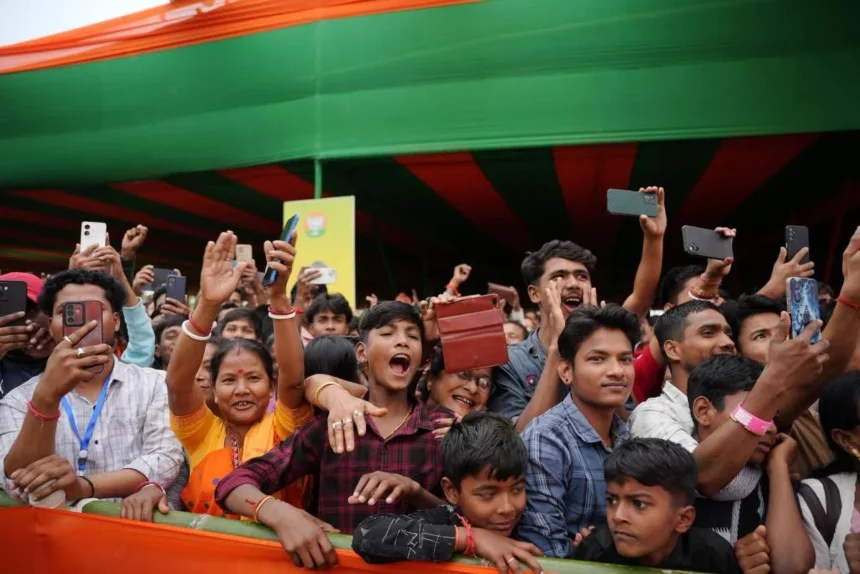
Political parties in Assam are stepping up efforts to attract young voters ahead of the Assembly elections by offering financial assistance, education support, and job-related promises. With youth forming a large share of the electorate, these initiatives are becoming central to campaign strategies.
Read More: PM Modi Chairs CCS Meet on Tackling West Asia Crisis – Hindustan Pioneer
Youth Voters Become Key Focus in Assam Elections
As the Assembly elections approach in Assam, political parties are increasingly targeting young voters, who make up a substantial portion of the state’s 2.5 crore electorate. Notably, over six lakh new voters aged 18–19 and around 66 lakh voters aged 20–29 are expected to play a decisive role in shaping the outcome.
Recognising this influence, both ruling and opposition parties have rolled out youth-centric initiatives aimed at addressing education, employment, and financial challenges.
BJP Highlights Welfare Schemes for Students and Youth
The ruling Bharatiya Janata Party has emphasised several schemes designed to support students and young professionals. Among the flagship programs is Nijut Moina, launched in 2024, which provides financial assistance of up to ₹2,500 per month to girls from Class 11 to postgraduate level. The scheme aims to reduce school dropouts and curb child marriage.
Additionally, the Mukhya Mantrir Nijut Babu Asoni scheme, introduced in January, offers financial aid to boys enrolled in first-year undergraduate and postgraduate courses.
Other initiatives include Jibon Prerena, which grants ₹25,000 annually to fresh graduates, and Jibon Anuprerna, which provides one-time stipends for research scholars. The government has also promoted entrepreneurship through programs like the Chief Minister’s Atmanirbhar Asom Abhiyan (CMAAA) and Swami Vivekananda Assam Youth Empowerment (SVAYEM).
Experts See Impact but Call for Long-Term Solutions
Academic voices have acknowledged the benefits of these schemes. Gauhati University assistant professor Karavi Barman noted that such initiatives help remove financial barriers, making higher education more accessible. Similarly, ABVP state secretary Manash Pratim Kalita stated that economically weaker students are particularly benefiting, as the schemes reduce the financial burden on families.
However, critics argue that these measures may not address deeper systemic issues.
Opposition Raises Concerns Over Sustainability
Opposition groups, including leaders from student organisations, have criticised the schemes as short-term solutions. The Students’ Federation of India has called for merit-based scholarships and structural reforms in the education sector.
State secretary Rajdeep Mahanta highlighted challenges such as limited government college seats, a rise in self-financed courses following the implementation of National Education Policy 2020, and increasing fees in autonomous institutions. According to critics, these issues require long-term policy interventions rather than temporary financial support.
Election Promises Focus on Jobs and Skill Development
As campaigning intensifies, the BJP has promised to expand its existing welfare schemes, while the Indian National Congress is focusing on creating job opportunities within the state.
Experts have stressed that beyond financial incentives, preparing youth for a changing job market is crucial. They suggest measures such as public coaching for competitive exams, skill development programs, and sustainable employment opportunities to ensure long-term benefits.
Polling Schedule
Polling for the 126 Assembly seats in Assam is scheduled for April 9, with results expected on May 4. With youth voters at the center of political strategies, their participation is likely to significantly influence the election outcome.
Also Read: Dibang Valley Holds Public Hearing on 680 MW Attunli Hydropower Project – Prime 24 Seven