


Mizoram corruption efforts received a fresh push on Thursday as Chief Minister Lalduhoma directed officials to take strong action against graft and ensure that investigations are handled strictly and fairly. He also stressed that no person should be spared during investigations.
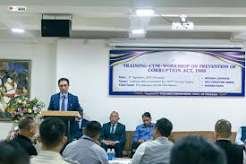
Lalduhoma was speaking at the inauguration of a training-cum-workshop on the Prevention of Corruption Act, 1988. The programme was organised by the state Vigilance Department for officials of the Mizoram Lokayukta, Anti-Corruption Bureau (ACB) and state police.
Mizoram corruption action gets renewed focus
The chief minister said his government remained committed to building a transparent and clean administration. He also highlighted steps taken to strengthen institutions responsible for investigating corruption in the state.
According to Lalduhoma, the government has sanctioned new vehicles for the ACB. It has also extended vehicle entitlements to inquiry officers of the Lokayukta.
Moreover, the government has restored a special incentive allowance for ACB personnel. The allowance had been discontinued during the COVID-19 pandemic. Similar incentives have now been introduced for Lokayukta inquiry officers.
Funds have also been allocated for anti-corruption awareness campaigns, the chief minister said.
Officers urged to act strictly and fairly
Lalduhoma told inquiry officers that the law gives them considerable powers. Therefore, he urged them to use those powers strictly while ensuring fairness during investigations.
He stressed that investigations should not spare anyone. The direction underlines the government’s stated approach of dealing firmly with corruption while allowing investigative agencies to follow due legal procedures.
The chief minister also called for better coordination between the Vigilance Department and other government departments. Such coordination, he said, would help make investigations more effective.
The workshop focused on the Prevention of Corruption Act, 1988, providing officials from key anti-graft institutions an opportunity to strengthen their understanding of the law and its application.
Stronger institutions remain central to Mizoram corruption policy
The government has sought to reinforce the ACB and Mizoram Lokayukta as part of its wider anti-corruption efforts. These institutions have a central role in receiving complaints, conducting inquiries and pursuing cases under applicable laws.
Earlier this year, Lalduhoma had also described corruption as a major obstacle to good governance and development. While releasing the ACB’s first annual report in July, he called for collective efforts from citizens and government employees to address the problem.
The report showed that the ACB received 17 corruption-related complaints during 2025-26. Of these, 15 were taken up for preliminary inquiry, resulting in six regular cases. The bureau also completed 14 preliminary inquiries and disposed of seven regular cases during the period.
Pending cases draw CM’s attention
At Thursday’s workshop, Lalduhoma also acknowledged the work carried out by anti-corruption officials. However, he noted that several inquiries and cases remained pending.
He directed officials to make every effort to dispose of these pending matters at the earliest. The instruction places faster case disposal alongside strict investigations as a priority for the state’s anti-corruption machinery.
The emphasis on pending cases comes as the government seeks to improve the functioning of institutions tasked with preventing and investigating corruption. Faster processing could also help reduce delays in inquiries and legal proceedings.
Mizoram corruption fight gets institutional support
The government’s measures include operational and financial support for anti-graft agencies. New vehicles for the ACB are intended to strengthen its logistical capacity, while vehicle entitlements and incentives for Lokayukta inquiry officers are aimed at supporting their official work.
Additionally, awareness funding signals an effort to address corruption through both enforcement and public participation. The government has previously maintained that combating corruption requires responsibility from public officials as well as citizens.
The latest directive also reinforces the administration’s broader clean-governance agenda. Lalduhoma’s government has repeatedly placed transparency, accountability and financial propriety among its governance priorities.
Senior officials, including Chief Secretary Khilli Ram Meena and state DGP Sharad Agarwal, attended the workshop.
With stronger institutional support and renewed instructions to speed up pending cases, the administration is seeking to give its anti-corruption campaign greater operational force. The effectiveness of the approach will depend on how consistently agencies investigate complaints, complete inquiries and pursue cases in accordance with the law.
Meghalaya Crush Maharashtra 3-0, Set Up Group C Decider Against Mizoram