





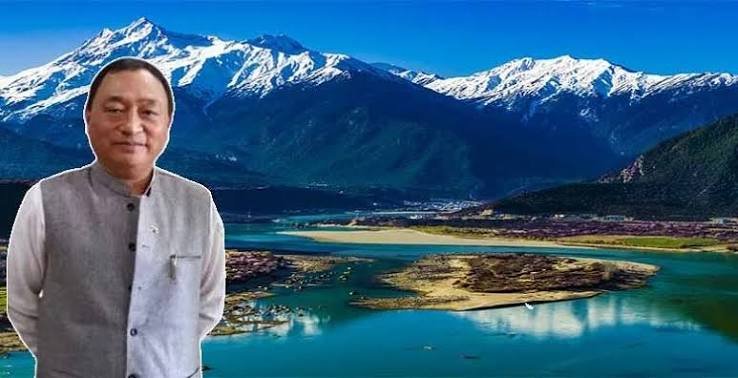
The Siang project has gained renewed political backing in Arunachal Pradesh, with Pasighat West MLA Ninong Ering saying he has long supported mega dams while calling for an informed and consultative approach.
Ering’s remarks come as the proposed Siang Upper Multipurpose Project (SUMP) remains at the pre-feasibility stage. The Arunachal Pradesh government has recently stressed that it will not rush the process and wants technical, environmental and social questions examined before taking major decisions.
Ering backs Siang project while seeking informed debate
Ering has consistently supported large hydropower projects, including the idea of using dams with storage capacity to address flood risks. In 2024, he also raised concerns in the Arunachal Pradesh Assembly about China’s planned mega dam on the Yarlung Tsangpo, the river known as the Siang in Arunachal Pradesh.
His latest position places support for the Siang project alongside a call for better information and community participation. That approach matters because the proposed project could affect people living along the Siang valley.
Ering has previously said that local concerns should be addressed before construction. Recent government-linked activities have also focused on consultation as officials seek support for the preparation of the project’s Pre-Feasibility Report (PFR).
Siang project remains in the study phase
The Siang project has not reached the construction stage. The immediate task is to prepare the PFR, which will help assess whether the proposed development is technically viable and what its wider effects could be.
In February 2026, 76 of 120 households in Karko village signed an MoU supporting PFR activities. Two more villages, Simong and Halleng, also signed agreements later that month. These developments show that some communities have backed the survey process, although support is not universal.
The state cabinet has now approved an Empowered High-Level Committee to oversee the PFR survey and related work. Chief Minister Pema Khandu said recently that the government was not rushing the project beyond its current feasibility stage.
Why the Siang project is strategically important
The proposed dam has been discussed not only as a hydropower project but also in terms of water management and strategic concerns. The Siang originates in Tibet as the Yarlung Tsangpo and enters Arunachal Pradesh before flowing into Assam as the Brahmaputra.
Khandu has argued that the project could help address risks linked to upstream water infrastructure. The government has also described the proposal as having broader national security implications because of its location near the international border.
However, those arguments remain part of a wider public debate. Any final decision will depend on technical studies, regulatory approvals and assessments of social and environmental impacts.
Siang project faces environmental and social questions
The scale of the proposal has made its possible impact a central issue. A 2026 study from the Centre of Excellence for Himalayan Studies at Shiv Nadar University noted strong opposition from sections of local communities and described concerns over ancestral land, cultural continuity and participation in decision-making.
The study also noted that the current proposal could affect several villages. Such concerns have prompted calls for detailed environmental and social assessments before any construction decision. Officials have repeatedly linked the preparatory stage to the need for transparent assessment and sustained engagement.
Meanwhile, the Arunachal Pradesh Congress has formed a panel to examine the proposed project’s social and environmental impact. The move reflects the continuing debate over how the project could affect local communities and the region’s ecology.
Siang project moves ahead through consultation
For now, the Siang project is moving through surveys and community-level discussions rather than construction. The PFR process is intended to provide more information on technical feasibility, environmental effects and social implications.
That makes Ering’s call for an informed approach significant in the current stage of the project. His support for mega dams does not remove the need to examine concerns raised by affected communities.
Overall, the next phase will depend on what the studies establish and how authorities respond to local views. The state government’s stated focus on a measured process leaves the project’s final shape open to further technical and public scrutiny, including further dialogue with affected residents.
Mizoram’s Chakma Council to Implement NEP From 2027-28, Introduce Weekly Mizo Speaking Day