




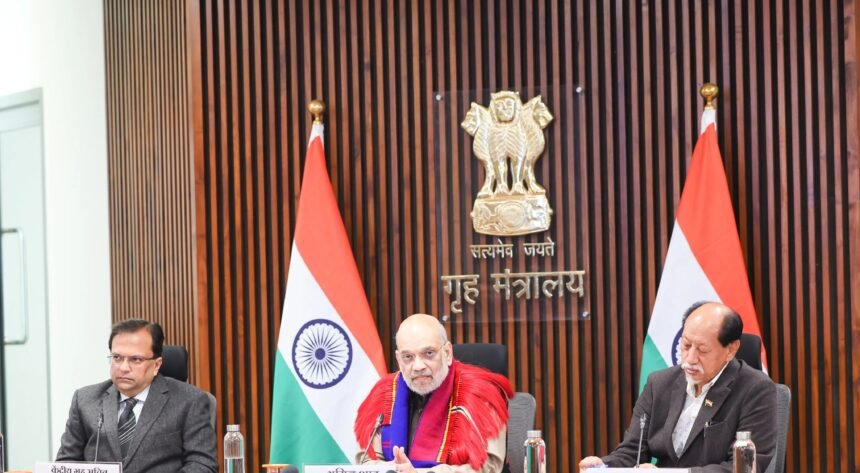
The Nagaland Special Assembly Session will be convened after the State Cabinet officially decided to hold a special sitting of the Legislative Assembly to enact the Frontier Nagaland Territorial Authority (FNTA) law. Moreover, the decision marks a significant step in the state’s legislative process concerning governance and administrative reforms for the Frontier Nagaland region. Consequently, the proposed session is expected to focus on deliberating and passing the legislation in accordance with constitutional and legislative procedures.
Amit Shah Reviews Arunachal Flood Situation With CM Pema Khandu
Border Narcotics Seizure Foils Major Cross-Border Drug Smuggling Attempt
Nagaland Special Assembly Session Approved by State Cabinet
The Nagaland Special Assembly Session was approved during a Cabinet meeting that resolved to convene the Legislative Assembly for considering the Frontier Nagaland Territorial Authority (FNTA) Bill. Furthermore, the decision reflects the government’s intent to move the proposed legislation through the formal legislative process.
Special Assembly sessions are convened to deliberate on important legislative matters requiring focused discussion. Consequently, the proposed session will provide lawmakers with an opportunity to debate the provisions of the FNTA law.
Moreover, the Cabinet’s approval represents a procedural milestone before the legislation is placed before the Assembly. Therefore, the next stage will involve legislative deliberations and consideration by elected members.
Additionally, officials are expected to complete the necessary administrative preparations before the session begins. Thus, the legislative process will proceed according to established parliamentary procedures.
FNTA Law Aims to Establish New Administrative Framework
The Nagaland Special Assembly Session will primarily focus on enacting the Frontier Nagaland Territorial Authority law. Furthermore, the proposed legislation seeks to establish an administrative framework for the Frontier Nagaland region in line with the government’s policy objectives.
Legislation creating statutory authorities typically defines administrative responsibilities, governance mechanisms, and institutional structures. Consequently, Assembly members are expected to examine the Bill’s provisions during the session.
Moreover, legislative debates allow elected representatives to discuss the potential administrative and developmental implications of the proposal. Therefore, the Assembly proceedings will play a crucial role in shaping the final legislation.
Similarly, statutory reforms undergo formal scrutiny before becoming law. Additionally, legislative committees or discussions may contribute to refining the proposed framework where required.
Legislative Process Follows Constitutional Procedures
The Nagaland Special Assembly Session will proceed under the constitutional and procedural rules governing the State Legislature. Furthermore, the introduction, discussion, and passage of the FNTA Bill will follow established legislative practices.
State legislatures play a central role in enacting laws relating to governance and public administration. Consequently, Assembly debates provide an opportunity for elected representatives to express their views and propose amendments where appropriate.
Moreover, legislative transparency strengthens democratic governance by ensuring that important policy decisions receive public scrutiny. Therefore, the special session represents an important constitutional process.
Similarly, adherence to legislative procedures supports accountability and institutional stability. Additionally, orderly debate contributes to informed decision-making on significant policy matters.
Frontier Nagaland Proposal Remains a Key Governance Initiative
The Nagaland Special Assembly Session highlights the government’s continued focus on advancing the Frontier Nagaland Territorial Authority proposal through legislative approval. Furthermore, the proposed law forms part of broader efforts to address governance and administrative priorities in the Frontier Nagaland region.
Government initiatives involving new administrative institutions typically require legislative approval before implementation. Consequently, the Assembly session represents a critical step in the policy’s progression.
Moreover, effective implementation will depend on the successful completion of the legislative process. Therefore, lawmakers are expected to play a central role in determining the final shape of the FNTA law.
Similarly, continued dialogue among stakeholders contributes to informed policymaking. Additionally, legislative oversight remains essential for ensuring effective governance.
Conclusion
The Nagaland Special Assembly Session marks an important legislative development following the State Cabinet’s decision to convene the Assembly for enacting the Frontier Nagaland Territorial Authority law. Moreover, the session is expected to facilitate detailed discussions on the proposed administrative framework for the region.
Furthermore, the legislative process will proceed in accordance with constitutional procedures, allowing elected representatives to debate and consider the provisions of the FNTA Bill. Consequently, the special session represents a significant milestone in the state’s governance agenda.
Looking ahead, transparent legislative deliberations, constitutional processes, and continued stakeholder engagement will remain essential as the proposed Frontier Nagaland Territorial Authority law moves toward enactment. Therefore, the Nagaland Special Assembly Session will play a pivotal role in shaping the future administrative framework for the Frontier Nagaland region.
FAQs
1. Why has the Nagaland Special Assembly Session been called?
The State Cabinet decided to convene a special session to consider and enact the Frontier Nagaland Territorial Authority (FNTA) law.
2. What is the main agenda of the special session?
The Assembly will deliberate on the proposed FNTA legislation and consider its passage through the legislative process.
3. What is the Frontier Nagaland Territorial Authority (FNTA)?
The FNTA is a proposed statutory administrative authority intended for the Frontier Nagaland region, subject to legislative approval.
4. How will the FNTA law be enacted?
The Bill will be debated and considered by the Nagaland Legislative Assembly in accordance with constitutional and legislative procedures.
5. Why is the Nagaland Special Assembly Session significant?
The session represents an important step in advancing the proposed FNTA law and shaping the future administrative framework for the Frontier Nagaland region.