





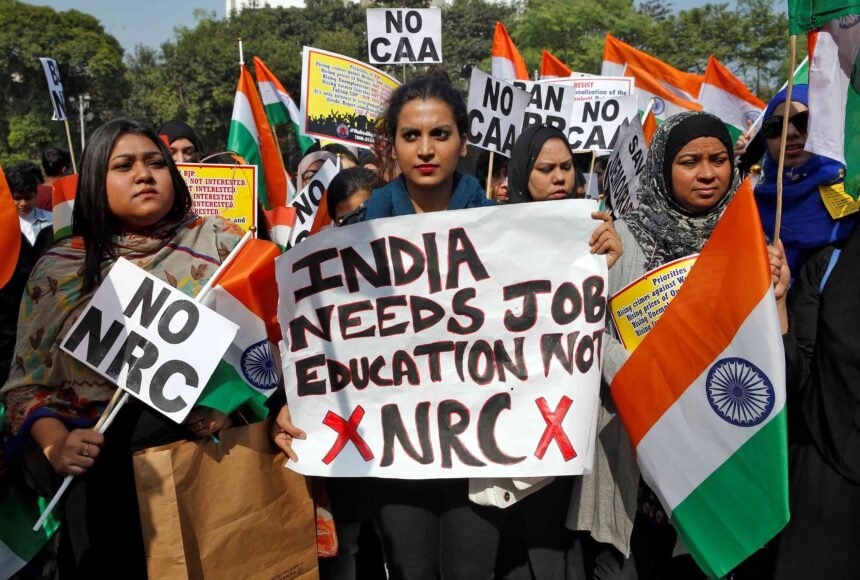
The Citizenship Amendment Act (CAA) and the National Register of Citizens (NRC) are two interconnected but distinct elements of India’s legal and administrative landscape. The CAA, enacted in 2019, seeks to grant citizenship to persecuted religious minorities from neighboring countries, while the NRC is a process designed to identify and register citizens residing in India. The amalgamation of these two initiatives has sparked widespread debates and controversies, with concerns about inclusivity, religious discrimination, and the potential impact on India’s diverse population.
Short Note on Citizenship Amendment Act (CAA):
The Citizenship Amendment Act, passed in December 2019, aims to provide a pathway to Indian citizenship for persecuted minorities—Hindus, Sikhs, Buddhists, Jains, Parsis, and Christians—from Pakistan, Bangladesh, and Afghanistan who entered India before December 31, 2014. The Act has faced criticism for excluding Muslims and altering the traditional secular fabric of Indian citizenship laws. Proponents argue that it addresses the humanitarian aspect of sheltering persecuted communities.
Short Note on National Register of Citizens (NRC):
The National Register of Citizens is a registry designed to identify genuine Indian citizens and weed out illegal immigrants. Initially implemented in Assam, the NRC verification process became controversial due to concerns about exclusion, bureaucratic challenges, and potential discrimination. The idea of a nationwide NRC has further intensified debates, with fears of rendering a large section of the population stateless.
Elaboration About CAA
- Historical Context of CAA: The roots of the CAA can be traced back to the historical backdrop of religious persecution faced by minority communities in neighboring countries. This legislative move was perceived by its proponents as a humanitarian response to the suffering of these communities. However, critics argue that the Act introduces a religious criterion for citizenship, which they claim is inconsistent with the secular principles enshrined in India’s constitution.
- CAA and Religious Exclusion: The controversy surrounding the CAA primarily revolves around the exclusion of Muslims from the list of eligible religious communities. Critics contend that this selective approach challenges India’s commitment to secularism and equality. The government, on the other hand, asserts that the Act is focused on protecting persecuted minorities and does not affect the existing rights of Indian citizens.
- NRC in Assam and Controversies: The NRC was initially implemented in Assam to address concerns about illegal immigration, particularly from Bangladesh. However, the process was marred by bureaucratic complexities, errors in documentation, and allegations of bias. Many genuine citizens found themselves excluded, leading to fears of statelessness. This raised questions about the feasibility and fairness of implementing a nationwide NRC.
- Nationwide NRC and Apprehensions: The proposal for a nationwide NRC has triggered apprehensions among various segments of the population. There are concerns about the logistical challenges of conducting such an exercise on a massive scale and the potential for discrimination against marginalized communities. Critics argue that it could disproportionately affect vulnerable populations who might struggle to provide extensive documentation.
- Interconnection and Public Response: The interconnection between the CAA and NRC has become a focal point of public discourse. While the CAA sets the criteria for granting citizenship, the NRC is the mechanism for verifying it. The fear of being excluded from citizenship has led to widespread protests, with citizens expressing their concerns about the potential consequences on India’s social fabric.
- Global Perspectives and Diplomatic Ramifications: The CAA-NRC issue has also attracted attention on the global stage. Critics argue that it might impact India’s image as a secular and inclusive democracy. Diplomatically, concerns have been raised about strained relations with neighboring countries, particularly those whose citizens may be affected by the CAA.
In addition , the Citizenship Amendment Act and the National Register of Citizens, while distinct in their objectives, have become intertwined in the public discourse, raising complex questions about identity, inclusion, and the future of India’s secular fabric. The ongoing debates highlight the need for a balanced approach that addresses humanitarian concerns without compromising the principles of equality and diversity.