





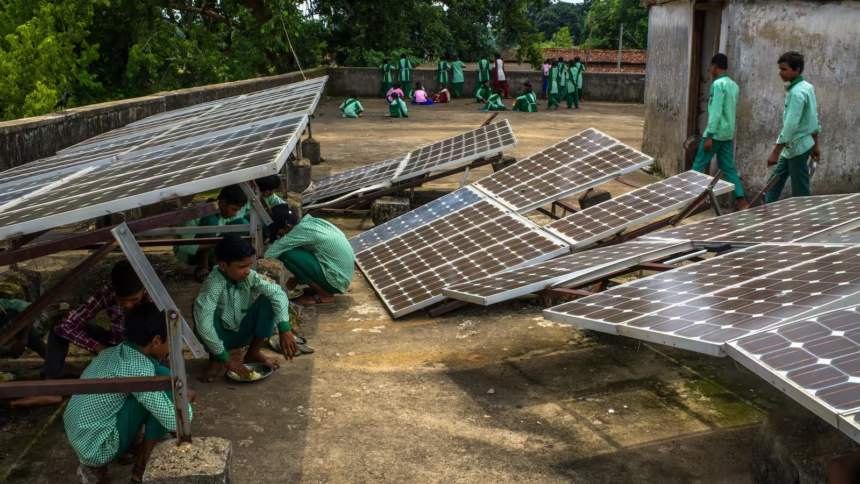
Arunachal Pradesh has signed a Memorandum of Understanding (MoU) with a global non-profit organisation to implement solar micro-grid installations in remote villages across the state. The initiative aims to expand access to clean and reliable electricity in off-grid and hard-to-reach areas. Moreover, officials stated that the project will strengthen rural infrastructure and support sustainable development goals. The agreement reflects a major step toward renewable energy adoption in the region.
Imphal West District Administration Organises Mass Welfare Camp
Assam Rifles Engages With Civil Society Organisations in Tamenglong to Bolster Border Peace
Partnership Focuses on Clean Energy Expansion in Remote Areas
Arunachal Pradesh signs MoU with global non-profit for solar micro-grid installations in remote villages to improve electricity access in underserved regions. Consequently, the project will target villages that currently face limited or no grid connectivity.
The solar micro-grids will be designed to provide decentralized power supply systems. Moreover, these systems are suitable for mountainous terrain and isolated settlements. Therefore, they offer a practical solution for energy access challenges in remote areas.
Officials highlighted that the initiative aligns with India’s broader renewable energy goals. Furthermore, it supports efforts to reduce dependency on conventional fossil fuel-based power. As a result, the state is expected to make significant progress in clean energy deployment.
Meanwhile, technical teams will conduct site assessments before installation. Consequently, suitable locations will be identified based on sunlight availability and community needs.
Strengthening Rural Electrification Through Renewable Energy
The MoU aims to strengthen rural electrification by deploying solar micro-grid systems in remote villages. Moreover, many habitations in Arunachal Pradesh are located in difficult terrain. Therefore, traditional grid expansion is often challenging and costly.
Solar micro-grids provide localized energy generation and distribution. Consequently, they reduce transmission losses and improve reliability. Such systems are increasingly being adopted in off-grid regions worldwide.
Furthermore, the initiative is expected to support essential services such as lighting, education, and healthcare. As a result, rural living standards may improve significantly.
Meanwhile, local communities will be involved in maintenance and operation training. Similarly, capacity-building programmes are being planned.
Collaboration With Global Non-Profit for Sustainable Development
Arunachal Pradesh signs MoU with global non-profit for solar micro-grid installations in remote villages as part of an international collaboration on sustainable development. Moreover, the partnership brings technical expertise and funding support. Therefore, implementation efficiency is expected to improve.
The global non-profit will assist in system design, installation, and training. Consequently, local stakeholders will benefit from knowledge transfer. Such collaboration strengthens long-term project sustainability.
Furthermore, the initiative supports climate-friendly energy solutions. As a result, carbon emissions from conventional energy sources can be reduced.
Meanwhile, monitoring systems will track performance and energy output. Similarly, regular evaluations will ensure system reliability.
Socio-Economic Impact on Remote Communities
The solar micro-grid project is expected to bring significant socio-economic benefits to remote villages in Arunachal Pradesh. Moreover, reliable electricity access can improve education and communication facilities. Therefore, it supports overall community development.
Electricity availability enables extended study hours for students. Consequently, educational outcomes may improve in rural areas. Such benefits contribute to long-term human development.
Furthermore, small businesses and local enterprises can operate more efficiently with stable power supply. As a result, rural economic activity is likely to grow.
Meanwhile, healthcare centres in remote villages will also benefit from uninterrupted electricity. Similarly, digital connectivity services may expand with better power infrastructure.
Conclusion
Arunachal Pradesh signs MoU with global non-profit for solar micro-grid installations in remote villages, marking a major step toward expanding renewable energy access in difficult terrains. Moreover, the initiative strengthens rural electrification and promotes sustainable development.
The project is expected to improve living standards, support education, and boost local economies. Therefore, it represents a significant advancement in clean energy infrastructure.
As Arunachal Pradesh signs MoU with global non-profit for solar micro-grid installations in remote villages, it underscores the state’s commitment to sustainable and inclusive energy development.
FAQs
1. What agreement has been signed?
An MoU with a global non-profit for solar micro-grid installations.
2. Where will the project be implemented?
Remote villages in Arunachal Pradesh.
3. What is the main goal?
To provide clean and reliable electricity in off-grid areas.
4. What type of energy system is used?
Solar micro-grids.
5. What are the expected benefits?
Improved education, healthcare, and rural development.