





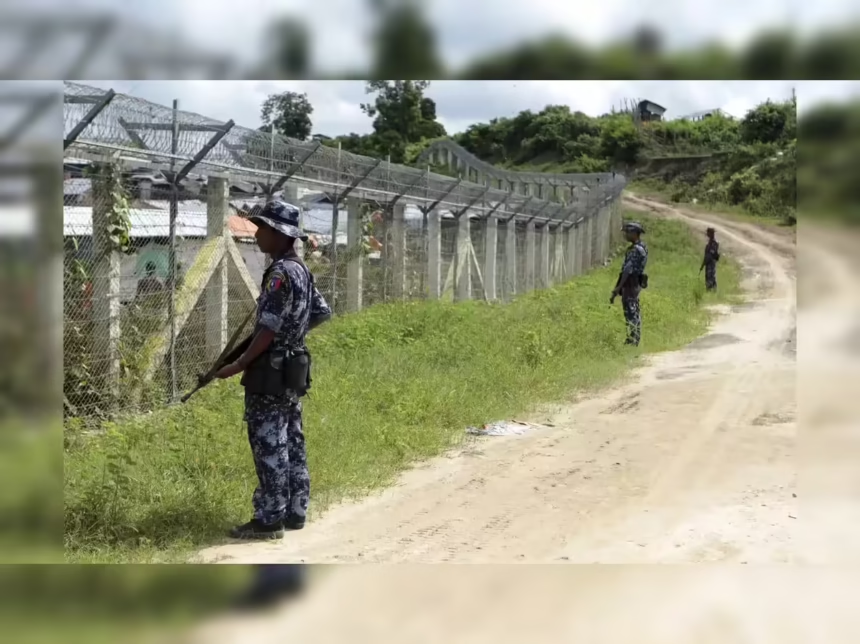
India’s ongoing review of refugee management and border control measures along the Myanmar frontier has brought renewed attention to the security and humanitarian challenges facing the northeastern states of Manipur and Mizoram. Moreover, the continued instability in Myanmar has contributed to cross-border movements, prompting authorities to reassess strategies related to border security, refugee management, and regional stability. The developments underscore the complex balance between humanitarian concerns and national security priorities in India’s Northeast.
Conrad K. Sangma Inaugurates 2026 Event in Shillong
Centre Assures Unlimited Logistical Support to Northeast States During Ongoing Monsoon Emergencies
India Reviews Border Security Strategy Amid Continued Refugee Influx
The focus on India Reviews Refugee Influx Strategy for Manipur and Mizoram Border Security reflects growing concerns about the impact of ongoing instability in Myanmar on India’s northeastern frontier. Furthermore, policymakers have increasingly emphasized the need for a coordinated approach that addresses security challenges while considering humanitarian responsibilities.
The India-Myanmar border extends across several northeastern states, including Manipur and Mizoram. Consequently, developments in Myanmar often have direct implications for local security, migration patterns, and cross-border trade. Experts have noted that the evolving situation requires state-specific responses rather than a uniform national strategy.
Manipur Faces Distinct Security Challenges
Manipur has experienced heightened security concerns due to its geographic location and complex ethnic dynamics. Moreover, authorities have expressed concerns about the movement of refugees, armed groups, and illicit trafficking networks across the porous border.
Security analysts have argued that the situation in Myanmar has intensified existing challenges in Manipur, including concerns related to arms trafficking, narcotics smuggling, and communal tensions. Therefore, border management measures in the state have increasingly focused on surveillance, intelligence sharing, and enhanced enforcement mechanisms.
Additionally, the ongoing instability in neighboring regions has reinforced calls for stronger border infrastructure and improved monitoring systems. Consequently, Manipur remains a key focus area in India’s broader northeastern security strategy.
Mizoram Continues to Balance Humanitarian and Security Concerns
Unlike Manipur, Mizoram has historically adopted a more humanitarian approach toward displaced persons entering from Myanmar, particularly due to longstanding ethnic and cultural ties between communities on both sides of the border. Furthermore, local authorities and civil society groups have played a significant role in providing support to displaced populations.
However, the continued influx of refugees has created logistical and administrative challenges. Moreover, state leaders have acknowledged that sustained migration flows place additional pressure on local resources and infrastructure. Consequently, discussions have increasingly focused on balancing humanitarian assistance with long-term security and administrative considerations.
The strategic importance of Mizoram has also increased due to its role in India’s Act East policy and connectivity initiatives. Therefore, maintaining stability in the state remains a national priority.
Myanmar Crisis Continues to Shape India’s Northeast Policy
The continuing conflict in Myanmar has emerged as a major factor influencing India’s security and foreign policy calculations in the Northeast. Moreover, experts have highlighted that refugee movements, cross-border crime, and regional geopolitical competition have become interconnected challenges.
Analysts have argued that prolonged instability in Myanmar could continue to affect border states through increased migration pressures, narcotics trafficking, and disruptions to connectivity projects. Consequently, India has increasingly emphasized a combination of border management, diplomatic engagement, and regional cooperation to address these challenges.
Furthermore, developments in neighboring countries and shifting regional dynamics have reinforced the need for flexible and state-specific approaches. Thus, policymakers continue to review strategies aimed at maintaining security while addressing humanitarian realities.
Conclusion
The ongoing efforts under India Reviews Refugee Influx Strategy for Manipur and Mizoram Border Security reflect the complex challenges facing India’s northeastern frontier. Moreover, the evolving situation in Myanmar continues to influence security planning, migration management, and regional cooperation efforts.
While Manipur remains focused on strengthening security mechanisms, Mizoram continues to balance humanitarian considerations with administrative and strategic priorities. Consequently, different approaches have emerged based on local realities and historical circumstances.
Looking ahead, India’s response is likely to continue combining border security measures, humanitarian assistance, and diplomatic engagement. Therefore, the review of refugee influx strategies remains a significant aspect of the country’s broader approach to maintaining stability in the Northeast.
FAQs
1. Why is India reviewing refugee influx strategies in Manipur and Mizoram?
India is reviewing its approach due to continuing instability in Myanmar and the resulting impact on border security, migration management, and regional stability.
2. Why do Manipur and Mizoram face different challenges?
Manipur faces significant security concerns related to cross-border movements and internal tensions, while Mizoram has historically adopted a more humanitarian approach due to ethnic and cultural ties with communities in Myanmar.
3. How has the Myanmar conflict affected India’s Northeast?
The conflict has contributed to refugee movements, security concerns, and challenges related to border management and regional connectivity.
4. What role does border security play in the current review?
Border security remains a central focus, particularly regarding surveillance, intelligence-sharing, and preventing illegal cross-border activities.
5. Why is the issue important for India’s regional strategy?
The situation affects national security, humanitarian policy, regional connectivity initiatives, and India’s broader strategic interests in Southeast Asia.