







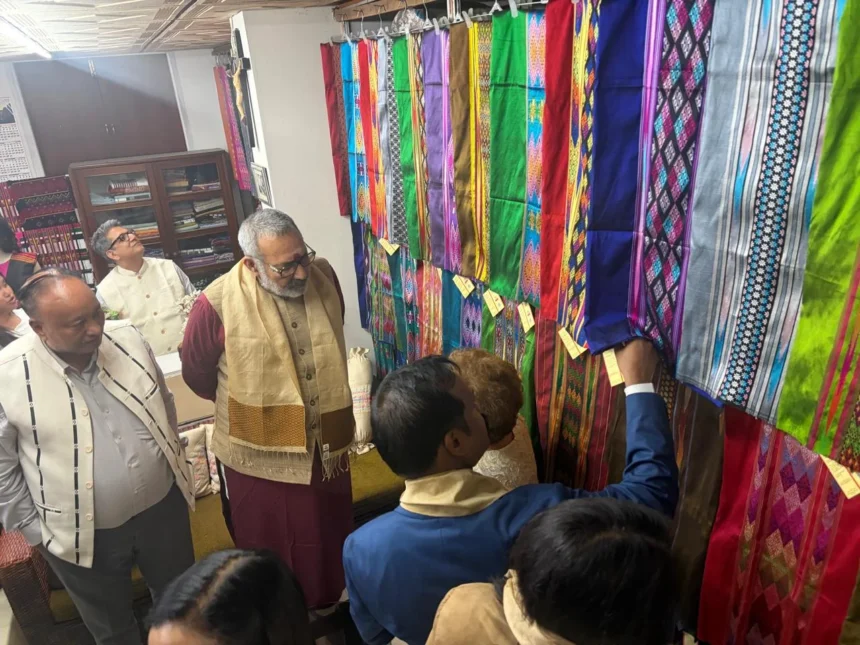
Union Minister of Textiles Giriraj Singh visited the Sericulture Training Institute (STI) at Zemabawk in Mizoram to review silk development initiatives. He interacted with farmers and proposed a cluster-based strategy to boost production of Muga, Eri, Mulberry, and Tasar silk. The minister highlighted the sector’s steady growth and announced support under Silk Samagra 2.0. He also encouraged innovation and collaboration to strengthen livelihoods linked to sericulture.
Read More: Kangpokpi Murder: Elderly Woman Killed, Robbery Suspected
Key Facts
- Event: Visit to Sericulture Training Institute (STI)
- Location: Zemabawk, Mizoram
- Key Person: Giriraj Singh, Union Minister of Textiles
- State Minister Present: Lalthansanga
- Sector Coverage: Muga, Eri, Mulberry, Tasar silk
- Beneficiaries: ~6,000 farmers, 19,000 people
- Districts Covered: 11 districts in Mizoram
- Growth Rate: Around 5.5–6% annually
- Scheme: Silk Samagra 2.0
Minister Reviews Sericulture Facilities
Union Minister Giriraj Singh visited the Sericulture Training Institute at Zemabawk on Monday. He was accompanied by Lalthansanga and officials from the Central Silk Board.
The visit began with a ceremonial plantation of Som saplings, which serve as the primary food source for Muga silkworms. Subsequently, the minister inspected the Silk Reeling Factory located within the institute campus.
Interaction with Farmers and Weavers
After the inspection, the minister interacted with farmers and weavers during a function held at the conference hall. He greeted participants from 211 villages and acknowledged their role in strengthening the sericulture sector.
Moreover, he praised Mizoram for being the only state in Northeast India capable of producing all four major silk varieties. This unique advantage, he noted, places the state in a strong position for future growth.
Cluster-Based Development Plan Announced
To accelerate development, Singh proposed a cluster-based approach for silk production. He suggested that Lunglei, Champhai, Saitual, and Siaha districts should focus on Muga silk production.
Meanwhile, other districts can specialise in Eri, Mulberry, or Tasar silk. This targeted strategy aims to improve efficiency and increase output across regions.
Additionally, the minister confirmed that the government has already sanctioned significant funds under Silk Samagra 2.0. He also encouraged healthy competition among farmers to reward high performers.
Focus on Innovation and Collaboration
Singh stressed the importance of innovation in the textile sector. Therefore, he proposed collaboration with the National Institute of Fashion Technology to support weavers and entrepreneurs.
Such partnerships, he said, will help improve design, marketing, and overall value addition in silk-based products.
State Government Highlights Progress
Mizoram’s Sericulture Minister Lalthansanga acknowledged the benefits of central schemes. He stated that cocoon processing units have already been set up under Silk Samagra 2.0.
Furthermore, he noted that local farmers now sell cocoons to other states, which has improved their income. He also reaffirmed that sericulture remains a priority under the state’s Bana Kaih programme.
Q&A Section
What happened?
Union Minister Giriraj Singh visited the STI in Mizoram and reviewed sericulture development.
What did the minister propose?
He proposed a cluster-based model for silk production across districts.
How many people depend on sericulture in Mizoram?
Around 6,000 farmers and 19,000 individuals rely on the sector.
Which silk varieties are produced in Mizoram?
Muga, Eri, Mulberry, and Tasar silk.
What support has the government provided?
Funds have been sanctioned under Silk Samagra 2.0 to boost the sector.
Location Context
Mizoram, a key state in Northeast India, holds strong potential in sericulture due to its climate and biodiversity. Therefore, strengthening this sector can significantly boost rural livelihoods and regional economic growth.

