



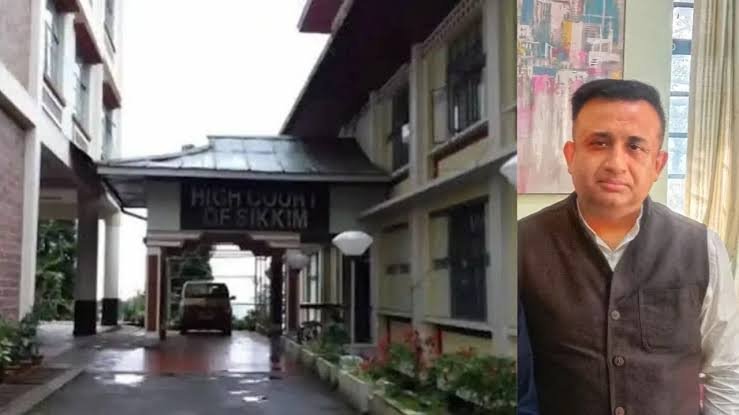
The Sikkim High Court has suspended Mangan District and Sessions Judge Prajwal Khatiwada with immediate effect, pending disciplinary proceedings. The Full Court approved the decision through an administrative order dated November 4, 2026. The development comes weeks after Khatiwada approached the Supreme Court, alleging that he faced targeted administrative action following a complaint against a then-serving High Court judge. However, the suspension order does not refer to that complaint or his Supreme Court petition. Instead, it cites alleged administrative irregularities, unsatisfactory replies to show-cause notices and concerns over his official conduct.
Gauhati High Court Quashes Pranab Doley’s NSA Detention
Full Court Approves Immediate Suspension
The Sikkim High Court’s Full Court took the decision to suspend Khatiwada, who currently serves as the District and Sessions Judge at Mangan.
The administrative order, dated November 4, places him under suspension until further orders. The suspension will remain in force while disciplinary proceedings continue.
The Full Court stated that it had examined his explanations to two show-cause notices. It found his responses prima facie unsatisfactory and concluded that his continuation in office was not conducive to the proper administration of justice.
The order also referred to concerns about his conduct and the tone of his written replies.
Importantly, the suspension remains an interim administrative measure. It does not amount to a final finding of guilt against the judicial officer.
Allegations Relate to His Tenure as Registrar General
A major part of the disciplinary proceedings concerns Khatiwada’s earlier tenure as Registrar General of the Sikkim High Court.
The Full Court’s order refers to alleged irregularities involving staff appointments, promotions and service upgradations.
According to the allegations, Khatiwada approved certain promotions and pay-related benefits without sufficient legal or administrative grounds. The proceedings also question appointments that allegedly violated applicable rules.
The High Court’s order estimates the resulting financial loss at approximately ₹1.64 crore.
Khatiwada reportedly argued that several disputed administrative decisions had received approval from higher authorities. However, the Full Court did not accept that explanation as sufficient to remove his individual responsibility.
It maintained that approval from senior authorities would not automatically absolve an officer of responsibility for administrative decisions.
These allegations form part of the ongoing disciplinary process. The final outcome will depend on the examination of the charges and the judicial officer’s defence.
Other Grounds Cited in Suspension Order
The Full Court also referred to other issues while explaining its decision.
One concerned a communication dated August 6, in which Khatiwada questioned the manner in which officials examined witnesses during a vigilance inquiry.
Another issue involved his alleged failure to submit his Annual Confidential Report despite repeated directions.
The order also raised concerns about conduct considered unbecoming of a judicial officer.
Additionally, the Full Court criticised the language and tone of his replies to the show-cause notices. It described his approach as intemperate and accusatory.
Together, these issues contributed to the Full Court’s prima facie assessment that his continuation in office was not appropriate during the disciplinary process.
However, the allegations have not reached a final determination.
Khatiwada Had Approached Supreme Court Over Alleged Targeting
The suspension has attracted wider attention because Khatiwada had previously approached the Supreme Court over a separate grievance involving the High Court administration.
He filed a writ petition under Article 32 of the Constitution, challenging a show-cause notice issued on August 12, 2026.
According to his petition, the dispute began on December 12, 2025, when he lodged a complaint against a then-serving Sikkim High Court judge.
Khatiwada alleged that the judge had mistreated and humiliated him.
He further claimed that administrative action against him intensified after the judge became Acting Chief Justice shortly after the complaint.
His petition described subsequent administrative decisions as targeted actions linked to his earlier complaint.
These claims represent Khatiwada’s allegations. They have not been established through a final judicial finding.
Supreme Court Gives Liberty to Approach High Court
The Supreme Court considered Khatiwada’s petition on September 9, 2026.
A Bench comprising Chief Justice of India Surya Kant and Justices Joymalya Bagchi and V Mohana heard the matter.
The Bench gave Khatiwada liberty to approach the Sikkim High Court with his grievances. It also clarified that it had expressed no opinion on the merits of his allegations.
Therefore, the Supreme Court’s September decision did not establish whether Khatiwada had faced retaliation or whether the administrative action against him was justified.
The subsequent November 4 suspension order does not mention his complaint against the High Court judge or his Supreme Court proceedings.
Instead, the order sets out the administrative and disciplinary grounds considered by the Full Court.
Judge Denies Charges and Questions Disciplinary Process
Khatiwada has denied the allegations in his written defence addressing 33 articles of charge.
He has also questioned whether the disciplinary proceedings are legally maintainable.
His defence argues that decisions involving appointments, promotions and service upgradations fell within the authority of the Chief Justice under Article 229 of the Constitution.
He maintains that his role as Registrar General involved preparing notes and placing proposals before the Chief Justice under administrative directions.
Khatiwada has also referred to a Supreme Court order dated May 18, 2026, to support his interpretation of the Registrar General’s administrative role.
Regarding staff promotions, he has pointed to the recommendations of a Departmental Promotion Committee. He reportedly stated that the committee recommended the decisions unanimously and that he was only one of its members.
He has also questioned why the disciplinary proceedings proceeded against him alone over decisions involving the committee.
Furthermore, Khatiwada has raised procedural objections. He alleges that authorities did not provide important documents, including Full Court meeting minutes, required for his defence.
He has also challenged the time allowed to answer the charges. According to his submission, he received 30 days, including court holidays, to respond to 33 articles of charge.
He further claims that some allegations appeared for the first time in the formal charge memorandum.
The disciplinary authorities will have to consider these objections alongside the charges during the proceedings.
Judicial Administration and Institutional Questions
The case has drawn attention to the relationship between administrative accountability and disciplinary safeguards within the judiciary.
The High Court exercises administrative control over the district judiciary. It can take disciplinary steps against judicial officers through the prescribed procedures.
At the same time, the officer facing proceedings has the opportunity to contest the allegations and present a defence.
Khatiwada’s case involves two distinct sets of claims. The High Court’s disciplinary action concerns alleged administrative irregularities and official conduct. His earlier Supreme Court petition raised allegations of retaliation following a complaint against a High Court judge.
The suspension order does not establish a connection between these two matters.
Consequently, the disciplinary proceedings and Khatiwada’s allegations must be assessed on their respective records.
Disciplinary Proceedings Remain Pending
Khatiwada’s suspension will continue until further orders from the High Court.
The disciplinary process will examine the allegations, his written defence and the procedural objections he has raised.
The outcome could clarify responsibility for the disputed administrative decisions during his tenure as Registrar General.
It may also address his objections regarding access to documents and the time provided to answer the charges.
Meanwhile, the suspension prevents him from continuing his duties as District and Sessions Judge at Mangan during the period specified by the order.
The case remains significant for judicial administration in Sikkim. However, the final findings will depend on the completion of the disciplinary process and any further judicial proceedings.
Conclusion
The Sikkim High Court has suspended Mangan District and Sessions Judge Prajwal Khatiwada with immediate effect through a Full Court decision dated November 4, 2026. The order cites alleged administrative irregularities, concerns over official conduct and unsatisfactory replies to show-cause notices.
The development follows Khatiwada’s September approach to the Supreme Court, where he alleged retaliation after complaining against a then-serving High Court judge. However, the suspension order does not mention that complaint.
Khatiwada has denied the disciplinary charges and questioned the proceedings’ legal and procedural basis. The allegations against him remain unresolved, and the disciplinary process will determine the final outcome.
FAQs
1. Why has the Sikkim High Court suspended Prajwal Khatiwada?
The Full Court cited alleged administrative irregularities, concerns over his official conduct and unsatisfactory replies to two show-cause notices.
2. Which judicial position did Khatiwada hold?
He served as the District and Sessions Judge at Mangan, Sikkim.
3. When did the High Court issue the suspension order?
The Full Court issued the administrative suspension order on November 4, 2026.
4. What financial loss does the disciplinary order mention?
The order refers to an alleged financial loss of approximately ₹1.64 crore linked to disputed administrative decisions.
5. Why did Khatiwada approach the Supreme Court?
He filed a petition alleging that administrative action against him followed a complaint he lodged against a then-serving High Court judge.
6. Has the disciplinary inquiry established his guilt?
No. The proceedings remain pending, and Khatiwada has denied the allegations in his written defence.