





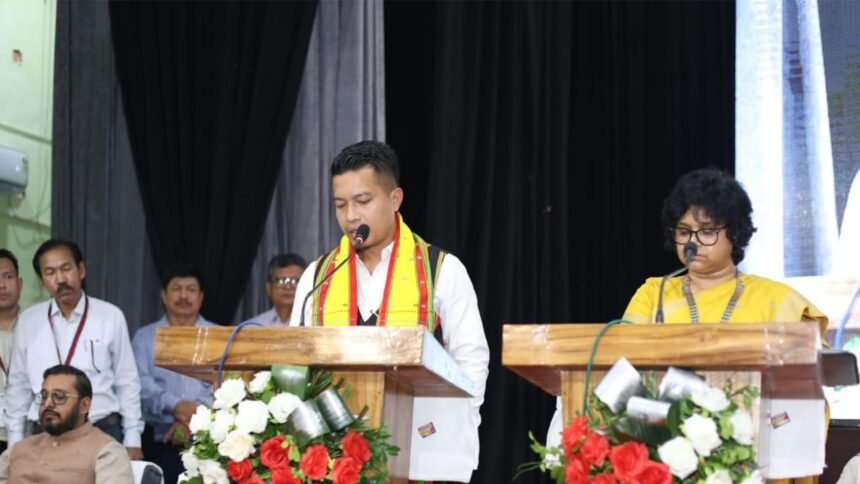
The TTAADC has formally constituted its new Executive Committee under the leadership of Runeil Debbarma as the Chief Executive Member (CEM). The formation of the new leadership marks an important political development within the autonomous council administration in Tripura.
Officials stated that the newly formed Executive Committee will oversee administrative, developmental, and governance-related responsibilities within the council areas. Moreover, political observers believe the leadership transition may influence policy priorities, regional development planning, and administrative coordination in tribal areas.
The development has drawn considerable attention across Tripura because the TTAADC plays a major role in governance and welfare programs concerning indigenous communities. Consequently, expectations regarding development initiatives and administrative reforms have increased following the formation of the new committee.
Manipur Border Village Attack Raises Security Concerns
Meghalaya Football Capital Push Gains Momentum After State League Finale
New Executive Committee Formally Constituted
The TTAADC New Executive Committee was officially constituted with Runeil Debbarma assuming leadership as the Chief Executive Member.
Council representatives stated that the formation process was completed through official procedures and administrative formalities. Furthermore, the new leadership team is expected to focus on governance, infrastructure development, welfare schemes, and regional administrative coordination.
Political analysts noted that leadership changes within the autonomous council often carry significant administrative and political importance. As a result, public attention has shifted toward the priorities and policy direction of the newly constituted committee.
Officials also emphasized the importance of ensuring continuity in development programs and governance activities within council-administered regions.
Role of the TTAADC in Tripura
The Tripura Tribal Areas Autonomous District Council plays a central role in administering tribal-majority areas within the state.
Authorities stated that the council is responsible for overseeing matters linked to local governance, development planning, education, welfare, and cultural preservation in designated regions. Moreover, the institution remains an important administrative body representing indigenous communities in Tripura.
Experts explained that autonomous district councils are designed to support decentralized governance and regional self-administration. Consequently, decisions taken by the Executive Committee can significantly influence local development policies and welfare initiatives.
The TTAADC New Executive Committee will therefore play an important role in shaping future governance strategies in council areas.
Runeil Debbarma Assumes Leadership
Runeil Debbarma officially took charge as the Chief Executive Member following the constitution of the new committee.
Political observers stated that the leadership transition comes at a time when development, infrastructure, and welfare issues remain key priorities within tribal regions. Furthermore, expectations regarding administrative efficiency and policy implementation have increased after the formation of the new committee.
Supporters described the leadership appointment as an opportunity to strengthen governance and community-focused initiatives. Additionally, council representatives emphasized the importance of inclusive development and coordination with state authorities.
The new leadership is expected to oversee administrative planning and execution of multiple developmental programs in the coming months.
Focus on Development and Welfare Initiatives
Officials indicated that development projects and welfare programs are likely to remain central priorities under the newly formed Executive Committee.
Infrastructure improvement, education, healthcare, rural connectivity, and livelihood support continue to be major concerns within council-administered areas. Therefore, policy implementation and administrative coordination are expected to receive significant attention.
Experts also emphasized the importance of preserving cultural identity while promoting economic and social development in tribal communities. Moreover, effective governance within autonomous councils can contribute positively to regional stability and public confidence.
The TTAADC New Executive Committee is consequently expected to focus on balancing development needs with community interests.
Political Significance of Leadership Change
The constitution of a new Executive Committee carries political significance because the autonomous council remains an influential institution in Tripura’s governance structure.
Political analysts stated that leadership developments within the TTAADC often influence regional political discussions and public engagement. Furthermore, governance performance within council areas may affect broader administrative and developmental narratives in the state.
Observers also highlighted the importance of maintaining cooperation between the autonomous council and the state government for effective implementation of projects and welfare schemes. Consequently, coordination and policy execution are expected to remain closely monitored.
The latest leadership transition has therefore become a major political development in Tripura.
Public Expectations From the New Committee
Residents and community organizations expressed expectations regarding improved governance, infrastructure development, and welfare initiatives under the new Executive Committee.
Public discussions focused on issues such as road connectivity, employment opportunities, healthcare access, and educational support within tribal regions. Additionally, community leaders emphasized the importance of transparency and efficient administration.
Experts noted that public trust and administrative effectiveness often depend on timely execution of development programs and responsive governance practices. Therefore, the new leadership may face strong expectations regarding delivery and accountability.
The formation of the committee has generated renewed attention toward governance priorities in the autonomous council areas.
Conclusion
The formal constitution of the new Executive Committee under Runeil Debbarma marks an important leadership transition within the Tripura Tribal Areas Autonomous District Council. The development is expected to influence governance, welfare initiatives, and development planning across tribal-majority regions in the state.
As the new committee begins its administrative responsibilities, public attention will remain focused on policy implementation, infrastructure growth, and community welfare programs. The leadership transition may also shape broader political and governance discussions in Tripura in the months ahead.
FAQs
Who is leading the new TTAADC Executive Committee?
Runeil Debbarma has assumed leadership as the Chief Executive Member.
What is TTAADC?
The Tripura Tribal Areas Autonomous District Council is an autonomous administrative body in Tripura.
What are the responsibilities of the Executive Committee?
The committee oversees governance, development, welfare, and administrative activities in council areas.
Why is the leadership change significant?
The council plays a major role in governance and development within tribal-majority regions.
Which issues are expected to receive attention?
Infrastructure, education, healthcare, employment, and welfare initiatives are likely priorities.
Why is TTAADC important in Tripura?
It supports decentralized governance and represents indigenous community interests.