




Tripura growth has gained momentum over the past eight years, Chief Minister Manik Saha has said, pointing to improvements in governance, infrastructure, connectivity and economic activity across the northeastern state.
Saha has repeatedly highlighted the state’s development record while crediting administrative reforms and support from the Centre. His remarks come as Tripura seeks to strengthen its position as an emerging investment and connectivity hub in the Northeast.
Tripura growth reflected in governance gains
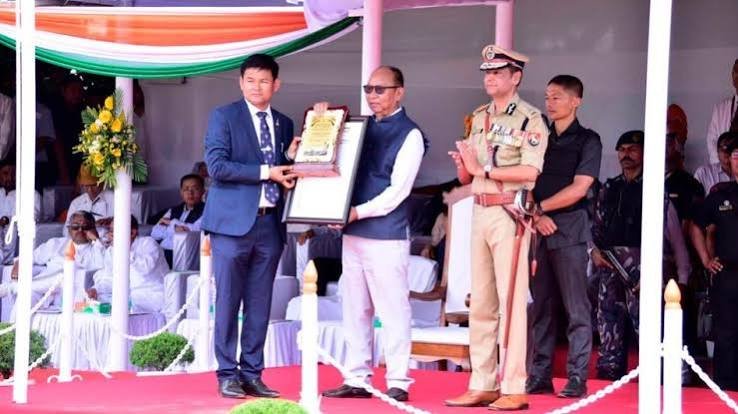
A major part of the government’s development narrative is its record in governance. Saha said Tripura received 347 national and regional awards over the past eight years, reflecting progress through administrative reforms and citizen-focused policies.
The chief minister has also described Tripura as the country’s seventh front-runner state in good governance. He said the government has focused on effective institutions, transparent decision-making and measurable outcomes rather than relying only on individual initiatives.
The Good Governance Department was established in August 2023. Later that year, the Tripura Institution for Transformation, or TIFT, was launched under NITI Aayog’s State Support Mission. The institution works on policy formulation, monitoring and evaluation.
Economic expansion adds to Tripura growth
Economic performance has also become an important indicator of Tripura growth. In January, Union Minister Jyotiraditya Scindia said the state had recorded annual growth of about 10.50% to 11%, compared with 3% to 4% earlier, and described the recent performance as faster than the national rate.
Scindia also said Tripura’s Gross State Domestic Product had shown strong expansion in recent years. Separately, Saha told the NITI Aayog Governing Council in June that the state’s GSDP had doubled over six years.
However, these figures represent government and official assessments of the state’s economic performance. Continued growth will depend on sustaining investment, creating jobs and expanding productive sectors.
Connectivity remains a key priority
Improved connectivity has been another major feature of Tripura growth. Scindia said the state’s national highway network had expanded from around 850 km 12 years ago to about 1,550 km. He also highlighted the completion of broad-gauge railway connectivity up to Sabroom in South Tripura.
Air connectivity has also improved, with Scindia saying flight services to the state had nearly doubled. These changes are important for trade, tourism, industry and movement between Tripura and other parts of the country.
Meanwhile, the state government has continued to seek stronger links with neighbouring countries and Southeast Asia. Saha has called for better regional connectivity and direct air links as part of a wider effort to expand Tripura’s economic opportunities.
Jobs, farmers and social sectors
The government has also pointed to employment and rural incomes as evidence of Tripura growth. In February 2026, Saha said the state government had provided 20,248 jobs over eight years, while stressing merit-based recruitment and transparent appointments.
The chief minister had earlier said average monthly farmer income increased from Rs 6,580 in 2016 to Rs 13,590 in 2024. He linked the rise to government schemes and support for agriculture, including income assistance, minimum support price procurement and credit facilities.
Education, healthcare, tourism, skill development and women’s empowerment have also featured in the government’s development agenda. Saha highlighted these areas during the NITI Aayog meeting in June, where he outlined the state’s longer-term development roadmap.
Tripura growth faces the next test
The government’s emphasis now is on turning recent gains into sustained development. Saha has said Tripura aims to align its long-term roadmap, Lakshya 2047, with the national goal of Viksit Bharat by 2047.
At the same time, Tripura must continue addressing employment needs, infrastructure gaps and the requirements of a growing economy. Therefore, the durability of Tripura growth will depend not only on headline indicators but also on how effectively development reaches households and businesses across the state.
Overall, the government’s recent claims point to a broad development push. With stronger connectivity, institutional reforms and rising economic activity, Tripura is seeking to build on its progress and establish a larger role in the Northeast’s future growth.