





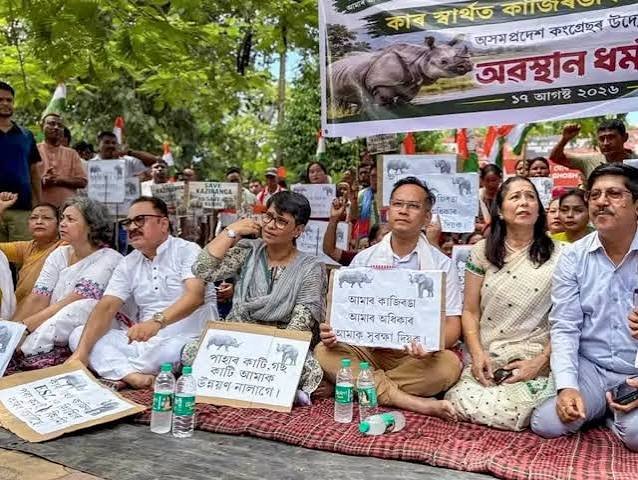
Kaziranga ESZ has become the focus of a fresh public debate in Assam, after residents near Kaziranga National Park protested in Kaliabor on Tuesday against demands to retain a 10-km buffer.
The protesters backed the Assam government’s proposal for a one-kilometre Eco-Sensitive Zone (ESZ). They opposed Congress leader Gaurav Gogoi’s demand for the existing 10-km protection area, according to reports. The debate has brought conservation, local livelihoods and development into sharp focus.
Kaziranga ESZ residents rally against wider buffer
Residents from areas surrounding Kaziranga took part in the protest in Kaliabor. They argued that a wider ESZ could place additional restrictions on economic activity and development in settlements around the park.
The demonstration comes amid a larger dispute over how the protected landscape should be regulated. For local communities, the issue is not only about wildlife protection. It also concerns the use of land, infrastructure and opportunities for development.
Meanwhile, the Assam government has proposed reducing the ESZ around Kaziranga from the current default 10 km to one km. The proposal has triggered criticism from environmentalists and conservation advocates, who fear that a smaller buffer could increase pressure on habitats outside the park.
Why the Kaziranga ESZ debate matters
An Eco-Sensitive Zone is intended to regulate activities around protected areas and reduce harmful pressure on wildlife habitats. It does not mean that every activity within the zone is automatically banned. Instead, activities are regulated according to environmental rules and the applicable notification.
Kaziranga is especially sensitive because wildlife can move beyond the park’s core boundary. Floods can also push animals towards higher ground outside the park. Therefore, conservationists argue that surrounding landscapes and movement routes need careful protection.
The legal position is also important. In a March 2026 judgment, the Gauhati High Court noted that Kaziranga did not have a final ESZ notification and that the 10-km direction remained operative. The court referred to the Supreme Court’s framework under which a wider proposed buffer continues until a final decision is made.
10-km demand draws political attention
Gaurav Gogoi has opposed the proposed reduction and called for the 10-km buffer to be retained. His position has become a major point of contention in the current public debate.
The role of Akhil Gogoi is also being mentioned in the political dispute because of his long-standing environmental activism and earlier legal interventions concerning protected areas. However, current reports on Tuesday’s protest specifically identify Gaurav Gogoi’s 10-km demand as a target of the residents’ opposition.
That distinction is important because political positions on environmental protection can vary across different issues and periods. Claims about either leader’s current position should therefore be separated from their earlier environmental campaigns.
Kaziranga ESZ proposal faces scrutiny
The Assam government has said the Kaziranga ESZ should follow a site-specific approach rather than relying on the default 10-km radius. The state’s proposal is yet to become a final central government notification.
Until that process is completed, the existing legal framework continues to matter. The recent Gauhati High Court judgment also highlighted that the absence of a final notification does not remove the operative 10-km protection.
Supporters of the state proposal say a narrower zone can balance conservation with the needs of people living around Kaziranga. Critics, however, argue that reducing the buffer could make development pressure harder to control, particularly in areas important for wildlife movement.
Balancing conservation and local needs
The latest protest shows why the Kaziranga ESZ issue is unlikely to be settled only through political statements. Local residents want development and livelihoods protected, while conservation groups want safeguards for habitats beyond the park boundary.
A final decision will need to address both concerns. It will also need to follow the applicable court directions and environmental procedures.
For now, the one-kilometre proposal remains a government plan rather than a final notified ESZ. The 10-km framework continues to operate, while political leaders, residents and environmental campaigners argue over what the permanent boundary should be.
The dispute therefore remains open, with the central question being how Assam can protect Kaziranga’s wildlife while allowing surrounding communities to pursue legitimate economic and social development.