
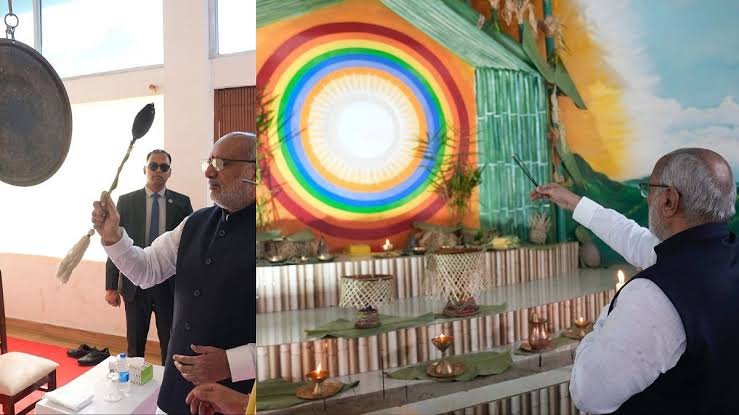
The Donyi-Polo Faith Centre Visit by Vice-President C. P. Radhakrishnan brought national attention to Nyedar Namlo in Itanagar, a sacred place of worship and community hub associated with the indigenous Donyi-Polo faith of the Nyishi community and other indigenous groups of Arunachal Pradesh. He visited the centre on September 9, 2026, during his first visit to the state.
During the visit, the Vice-President offered prayers at the prayer hall and received an overview of Nyishi beliefs, prayer practices and indigenous knowledge systems. Moreover, the programme highlighted the importance of preserving cultural traditions while allowing communities to participate fully in modern development.
Gopal Roy Demands Puja Grants for Tripura Clubs
Donyi-Polo Faith Centre Visit Highlights Nyedar Namlo’s Cultural Role
The Donyi-Polo Faith Centre Visit placed Nyedar Namlo at the centre of discussions about Arunachal Pradesh’s indigenous heritage. The site functions not only as a place of worship but also as a community hub connected with the Donyi-Polo faith followed by the Nyishi community and other indigenous groups.
Radhakrishnan offered prayers at the Nyedar Namlo prayer hall before receiving a briefing on indigenous beliefs and prayer systems. Officials and community representatives also explained the role of traditional knowledge and cultural practices associated with the community.
The visit therefore connected spiritual heritage with broader questions about cultural preservation. Rather than treating indigenous traditions only as historical elements, the Vice-President emphasised their continuing relevance to contemporary society.
Furthermore, he described Arunachal Pradesh as an example of India’s unity in diversity, where traditional values and modern aspirations can exist together.
Vice-President Emphasises Preservation of Indigenous Knowledge
One of the major themes of the visit involved the preservation of indigenous knowledge. Radhakrishnan was briefed about the Yerko indigenous Gurukul system, traditional medicinal knowledge and efforts to promote the mother tongue.
The Yerko system received particular attention because it represents an approach that connects education with indigenous knowledge and community traditions. The Vice-President highlighted the importance of allowing younger generations to engage with modern opportunities while maintaining connections with their cultural roots.
Similarly, traditional knowledge about medicinal practices forms part of the wider cultural heritage discussed during the visit. Preserving such knowledge requires communities to document, transmit and responsibly maintain their traditions across generations.
Meanwhile, language preservation also emerged as an important component. Efforts to promote the mother tongue can help strengthen cultural continuity, particularly as younger generations increasingly interact with wider educational, professional and social systems.
Consequently, the Donyi-Polo Faith Centre Visit was not limited to a ceremonial engagement. It also highlighted education, language, traditional knowledge and community institutions as important parts of indigenous heritage.
Donyi-Polo Values Draw National Attention
During the community gathering, Radhakrishnan spoke about values associated with the Donyi-Polo tradition, particularly its emphasis on nature, truth, harmony and community. He said these values remain relevant in the modern world.
He also said he felt honoured to visit a place where traditions can contribute to modern thinking without destroying traditional identity. The remarks reflected his broader emphasis on balancing development with preservation of indigenous culture.
The Vice-President further described tribal communities as partners in shaping India’s future rather than merely custodians of its past. His message placed indigenous communities within the country’s contemporary development narrative.
Moreover, he linked Arunachal Pradesh’s cultural identity with the wider idea of national unity. He noted the state’s combination of ancient traditions and modern aspirations while also highlighting the importance of its people in safeguarding the country’s territorial integrity.
The emphasis on cultural identity also carries significance for younger generations. Indigenous institutions can provide spaces where traditional practices, community values and contemporary education interact rather than develop separately.
Visit Connects Cultural Heritage With Wider Development
The Donyi-Polo Faith Centre Visit formed part of a broader Vice-President’s programme in Itanagar that included visits to cultural and educational institutions. Radhakrishnan also visited the Jawaharlal Nehru State Museum, which preserves ethnographic collections from Arunachal Pradesh and the wider Northeast.
The museum visit reinforced the importance of preserving tangible cultural heritage, including textiles, archaeological objects, paintings, basketry, woodwork, ornaments and household articles. The Vice-President described such institutions as bridges between generations.
He also visited the Donyi-Polo Mission School for the Hearing, Visually and Intellectually Impaired at Chimpu in Itanagar. There, he interacted with students, teachers and staff and highlighted the importance of ensuring that every individual has opportunities to develop their abilities.
Together, these engagements connected indigenous faith, cultural preservation and inclusive education. Therefore, the visit demonstrated a broader interest in institutions that preserve community heritage while supporting contemporary social development.
The significance of Nyedar Namlo lies particularly in its role as a living community institution. Its importance comes not only from its religious association but also from its connection with education, language, traditional knowledge and collective cultural identity.
Conclusion
The Donyi-Polo Faith Centre Visit by Vice-President C. P. Radhakrishnan at Nyedar Namlo highlighted the cultural and spiritual importance of indigenous traditions in Arunachal Pradesh. During his September 9 visit, he offered prayers and learned about Nyishi beliefs, the Yerko Gurukul system, traditional knowledge, medicinal practices and mother-tongue initiatives.
The visit also emphasised that cultural preservation and modern development can progress together. Radhakrishnan described tribal communities as important partners in India’s future and highlighted values associated with Donyi-Polo traditions, including nature, truth, harmony and community.
Therefore, the Donyi-Polo Faith Centre Visit gave national visibility to Nyedar Namlo while reinforcing the importance of protecting indigenous knowledge and cultural institutions for future generations.
FAQs
What was the Donyi-Polo Faith Centre Visit about?
The visit involved Vice-President C. P. Radhakrishnan visiting Nyedar Namlo in Itanagar, offering prayers and learning about the indigenous Donyi-Polo faith and associated cultural practices.
Where is Nyedar Namlo located?
Nyedar Namlo is located in Itanagar, Arunachal Pradesh, and serves as a sacred place of worship and community hub associated with the Donyi-Polo faith of the Nyishi community and other indigenous groups.
What indigenous traditions were discussed during the visit?
The discussions covered Nyishi beliefs and prayer systems, the Yerko indigenous Gurukul system, traditional knowledge, medicinal practices and efforts to promote the mother tongue.
What did the Vice-President say about Donyi-Polo values?
Radhakrishnan highlighted the tradition’s emphasis on nature, truth, harmony and community and said these values remain relevant to modern society.
Why was the Donyi-Polo Faith Centre Visit significant?
The visit highlighted the importance of preserving indigenous faith, cultural knowledge and community institutions while allowing traditional communities to participate in modern development.